Showing posts with label sheep. Show all posts

Thursday, 2 January 2020

Blizzard


A January Blizzard rolled in today.
After wonderful, mild winter weather,
I woke up to the wind howling, snow drifts and a true winter storm.
The wind was biting, although not very cold,
it felt like it looked, wicked!
Roy and I made sure we fed extra roughage, bedded with straw and let the calves into the corral area to have some extra shelter.
The main cow herd were fed in the bush and out of the wind.
The dogs, seemed to find the weather delightful and the horses were rather frisky too.


The Barn was barely visible.


Tuesday, 5 December 2017

On Raymond Coppinger

 This article appeared in The Shepherd's Magazine
By: Louise Liebenberg


Raymond Coppinger

Anyone who raised sheep in the late 1970’s and early 80’s will have probably have heard of Raymond Coppinger and his large-scale research, spanning a decade  on livestock guardian dogs. I think it is appropriate to give a nod to this man, who passed away in August 2017.  Raymond Coppinger was first a dog-man, and then got a Ph.D in Biology.  He started off with his feet firmly placed on the skis of a sled dog team. In 1976, he and his wife Lorna started the Livestock Guardian Dog Project at the Hampshire College.
In the late 1970’s LGDs was virtually unknown in the USA, this was a totally new concept of having dogs live with livestock to protect them from predators. At that time, the USA had been virtually wolf free for many decades, and ranchers were not accustomed to having to really protect their stock from large predators, coyotes did however wreck havoc on sheep flocks and much of the research was based on finding solutions to combat coyote predation. 

The first study conducted in the USA on LGDs was from S Linhart, R Sterner, T Carrigan and D Henne in 1977. Following this, in 1979 two other independent projects began to follow up the Linhart et al results. Ray Coppinger and his wife Lorna established the Livestock Dog Project (LDP) in Amherst, Massachusetts, and at about the same time, Dr. Norm Gates acquired several Hungarian Komondors for a long-term study of livestock guardian dogs at the U.S. Sheep Experiment Station(USSES) at Dubois, Idaho. (McGrew, 1983)

 No one had done any large-scale research into LGD at that time, and certainly to date, no one, other than Coppinger, has collected data from over 1000 dogs over a 10-year span. This research is still the single largest, long term study conducted on LGD anywhere in the world.  Initially, the Coppingers did a tour of ranches utilising LGD in the USA, and then they traveled to Europe and Turkey over a period of 3 months to observe and where possible, purchase pups of various breeds. He later purchased 10 puppies of three breeds, they were Maremma from Italy, Shar Planinatz (Sarplaninac) from Former Yugoslavia, and Anatolian dogs from Turkey.  At this time, it was extremely difficult to get pups out of Yugoslavia, stories of pups being transported down from the high mountains on donkeys, (personal communication) to be sent over to the USA, illustrates some of the challenges these dogs and the researchers faced. Some other breeds were donated to this project and were tested on a smaller scale.

The goals outlined in his study included the placement of dogs with producers and track their development, behaviour, and effectiveness in predator control, to  clarify “mechanisms of both successful and unsuccessful behavior by means of controlled studies” (Coppinger, Coppinger, Langeloh, Gettler, & and Lorenz, 1988) and finally to communicate these results back to various interested parties. The dogs were leased to producers so that the Hampshire College could still have access to these dogs for breeding or other research. Producers volunteered for this project and annually had to fill out a comprehensive report regarding the dogs, their behaviour and effectiveness.  News of the success of these dogs spread to other producers and the program grew to a point where over 1000 dogs were placed with livestock producers in 37 States. A secondary study led my Jay Lorenz, together with the Coppingers was initiated in Oregon.

 It was significant to note that this and some of the other studies, reported a reduction in predation when LGD were utilised on sheep flocks. These positive reports spurred the demand for more dogs and more sheep producers stepped into using LGD.

Coppinger studied both purebred and crossbred dogs. They also did heavy linebreeding to see what the effects would be on the dogs, to “determine if deleterious genes were present, and crossbred to test genetic or behavioral concordances, and enhancement or depression of structural and behavioral characteristics”. Now, 40 years later, one can criticize this work as being unethical regarding breeding practices, but at that time the breeding and crossbreeding of LGDs did provided pups to a growing group of producers needing and wanting these LGD,  and it provided additional  data on the effects of this breeding and breeds for their research. Having these offspring “out working” and getting feedback on them is what drove this study forward.

Some of the behaviours that Coppinger studied was the relationship between trustworthiness, attentiveness, and protectiveness of the dogs to their livestock. Today, some organizations still utilise these parameters to gauge how LGD are doing.  The relationships between these behaviours certainly play a significant role in the effectiveness of the LGD. I believe these three parameters are still relevant in assessing LGD behaviour today.

Coppinger is often blamed for promoting the “hands off” style of raising LGD. Many people now vilify him for this, as they feel this is one of the biggest myths he perpetuated. Reading the publications, I did not find anywhere, that it advocated that the pup should be reared with no human contact at all. Somehow, somewhere the message become distorted to the point that no handling became the norm. What was written by the Coppinger was that “minimal human contact” was recommended to allow the pup to form the sheep-dog bond. In the old 1990’s USDA ( with Jeff Green and partners) nowhere does it say that LGD should not be handled at all. (https://pubs.nal.usda.gov/sites/pubs.nal.usda.gov/files/LivestockGuardingDogs.pdf). In fact, they encourage some basic obedience training during the raising phase.
Coppinger did state that some dog/human interaction was required and that some petting was appropriate. (http://ir.library.oregonstate.edu/xmlui/bitstream/handle/1957/18914/ec1238.pdf). In all the early studies, it stressed the importance of early exposure to sheep in developing successful guardian dogs (Green and Woodruff 1983x; Coppinger and Coppinger 1980; 1982).

 It is interesting to note that Coppinger did find, after 10 years of studies on LGD, that success of the dogs could be attributed to (in part) to the amount of time a producer spent with his dogs. The dogs who were ineffective in the USA were “those where sheep scattered widely over a great area and never flocked, or where producers did not spend more than a minimal amount of time with the flock. The essential difference between management of dogs in this country (mainly farm operations) and in Europe (mainly range operations) tends to be the amount of time owner operators spend with their stock. “
(Coppinger, Coppinger, Langeloh, Gettler, & and Lorenz, 1988)

I personally question the blame laid at the feet of Coppinger for advocating for hands-off, feral dogs. His research has never advocated for this form of raising. I believe this myth was a general belief that existed at that time, were all working dogs (hunting, retrieving, herding, terriers etc), were presumed to be better working dogs if they were not petted and treated like house pets. This belief, combined with the need for LGD to bond to their sheep, morphed into this idea that LGD should not be handled and preferably left feral with the stock.

I think it is important to view the research done by the Coppingers in the time frame, (40 years ago) it was conducted. At that time, his work was ground breaking and it provided real science, a lot of data and a solution to predation issues for ranchers. For many ranchers, this was research/science that directly benefited them, and indirectly, the promotion of LGD allowed for more non-lethal predator control.  His work and research is still cited in most new research articles today and formed a basis from which other research has been conducted. It was pioneering to say the least.

With 40 years more of LGD use since the Hampshire College LGD Project started, there are new insights on how we raise and train our LGD. Times change, the sheep industry has changed and how we view dogs has changed. We do not have to agree with all his research, but I do think it is only right to tip our hats to a man that made LGD use in the USA and Canada accessible. Even Ray, over the years amended and corrected certain statements he originally made.  Having some misconceptions back then or a change in perceptions today, does not invalidate all the work he did.

 If it was not for that initial study of Coppinger, I would never have gotten to know the Shar Planinatz breed, and for that, I am grateful. To this day, I still read his research and I see new things or another aspect catches my attention. I have spoken with Coppinger numerous times, primarily about LGD and cattle, it was always interesting to share conversations and insights with him. People change, people learn and over the years Coppinger had some different reflections on his initial work. I do not believe we can blame Coppinger for all that is wrong with LGD now, and I am sure he has had a very big impact on keeping sheep safe in the USA. I believe his work and introduction of LGD to a broader sheep producing audience paved the way for better livestock, and indirectly, wildlife management today.
I would like to conclude this article on Coppinger and his Livestock Guardian Dog Project with his own words:
“Guarding dogs can reduce predation on farms and ranches by 60 to 70% or more. On an individual basis, reduction of losses to predators can be spectacular. For producers in areas where lethal controls are inappropriate, guarding dogs made staying in business possible. Problems within the system are solvable, given long-term recordkeeping and expert attention. We focus on the problems, but there have been far more successes than problems over the past 10 years. This management system has attracted increasing attention and use not only because of its effectiveness but because producers feel they can take charge of what happens on their farms or ranches. Dogs provide a good alternative to environmental liabilities of lethal control methods. Costs should decrease and effectiveness increase as more growers, extension agents, wildlife damage control personnel, and breeders become familiar with the system.” (Coppinger, Coppinger, Langeloh, Gettler, & and Lorenz, 1988)

Coppinger has written and number of books regarding dogs in general.

"Dogs: A Startling New Understanding of Canine Origin, Behavior & Evolution" from May 27, 2001, by Raymond Coppinger and Lorna Coppinger.

“What Is a Dog?”
from April 19,2016, by Lorna Coppinger and Raymond Coppinger.

“How Dogs Work” from October 22, 2015 by Raymond Coppinger and , Mark Feinstein.
“Genetics and the Behavior of Domestic Animals” from  April 22, 2013, by Raymond Coppinger, Kathryn Lord, Lorna Coppinger
And Ray Coppingers most favorite book; “Fishing Dogs: A Guide to the History, Talents, and Training of the Baildale, the Flounderhounder, the Angler Dog, and Sundry Other Breeds of Aquatic Dogs (Canis piscatorius) in 1996 by, Raymond Coppinger.

References

Coppinger, R., Coppinger, L., Langeloh, G., Gettler, L., & and Lorenz, J. (1988). A DECADE OF USE OF LIVESTOCK GUARDING DOGS. Proceedings of the Thirteenth Vertebrate Pest Conference. Retrieved from http://digitalcommons.unl.edu/vpcthirteen
McGrew, J. C. (1983). Guardian Dog Research in the U.S. Great Plains Wildlife Damage Control Workshop Proceedings. 282. Retrieved 08 25, 2017, from http://digitalcommons.unl.edu/gpwdcwp/282/


Photo 1: Photo found on Google Images at:
http://www.gazettenet.comrenowned-Hampshire-College-professor-Ray-Coppinger-dies-at-age-80-12019028
Raymond Coppinger

Photo 2 and 3: Photo of Noreen Lehfeldt, one of the producers who received a dog from the livestock Guardian Dog Project. This is Mara a Maremma sheepdog in 1985, one of the Coppinger project dogs given to Noreen Lehfeldt.

Sunday, 22 October 2017

The added benefits of living and working with LGD


Article written for the September 2017 issue of the SHEPHERDS MAGAZINE
©Louise Liebenberg (2017)


The job that livestock guardian dogs do is often more than “just” protecting the livestock, when living close to them, and having direct contact with them, one soon see’s the other jobs that the dogs do. I would like to share some of these anecdotes of things I have experienced with our Sarplaninac dogs.

Every morning, when I go out to the pasture to feed the dogs and check on the sheep, I always have a slight feeling of apprehension, we live in a very predator rich area, and our ranch has borders some wild country. Most mornings, the dogs are waiting for me at the gate. Feeding is a highlight and they usually are right there waiting for it. When one or more dogs are not at the gate, I start worrying, I run different scenarios through my head: is a dog hurt? Are they out patrolling?  Has something happened during the night or has something happened to the sheep?
The ewes were bale feeding at a fair distance from the gate, so I quickly checked over the field, to see if I could see if something was out of place. Ravens in the pasture are usually an ominous sign and often the first indicator of what I might find.  Mali did not come for feed.  No ravens. Ewes calmly feeding all seems calm.  I call to Mali but she still does not come. I start to walk out to the ewes, and call again.  I see her sitting up. Ah! She is there! As I get closer, I still do not see why she has not come. As soon as I am within 10 meters (30 feet) she bolts off to her food. I look behind a bale and there are just the legs of a sheep sticking out from under a bale. The poor unfortunate sheep must have lain down by the bale, and the bale must have toppled onto the sheep, killing the ewe, sometime during the night.
Mali was lying with this sheep, keeping the ravens and possibly other predators at bay. As soon as I was close enough, she must have decided that the dead sheep was now my problem, and she was free to go and get her food.  I really like that my dogs do watch over the dead stock, as I find it important to note down what the animal died of. Finding a dead sheep under a bale can be tough, Mali alerted me to this ewes’ position.
In the morning, my dogs are my first indicator of how the night went. If the dogs are hyper-vigilant, do not come for food, or if the dogs set themselves up in semi circle around the flock, facing towards the bush are tell tale signs that predators are in the area. For more than a week we noticed that our dogs were being very “guardy”, very alert, focussed and all business. We had a feeling that something “big” was out there, but did not know what.  It was only later that we had heard that a cougar had killed our neighbor’s colt that week, and that explains the behaviour of our dogs. The dogs certainly do help tell us what is going on. We might not always understand directly, but we have learnt to pay attention to the dogs.


A similar scenario happened a few years ago, none of the guardian dogs came when I went to check on them, after quite a search I found the dogs hanging out close to a rather big hole in a bush pasture. The dogs came to greet me as soon as they saw me, but quickly bolted back to the hole. I could not see anything out of the ordinary and carried on with my sheep checks. A while later, the dogs still did not leave that spot. On closer inspection, deep in the hole was an ewe, stuck. Her whole body was about 2 meters down the hole. With plenty of tugging, we got the ewe out alive and well. Had it not been for the dogs, I would probably have not found her and she would have died in that hole. Good dogs.


Some of the anecdotes are also not specifically sheep related. We usually have between 8 and 10 guardian dogs, they work in various groups and numbers as we need them. Sometimes running four or five intact females together can create a lot of tension and some “bitchy” behaviour. My two oldest females did not always see “eye to eye”, but for the most part they tolerated each other and settled on a truce. As my oldest female started to age more, and developed some health issues, it became apparent that the other female started looking out for her more and more. If the older female decided to stay out in the bush during the night, then the younger dog would head out and stay with her.  When one of the other dogs tried to bully the older female from her food, then the other female would step up and intervene allowing the older girl more time to eat. Many times, I would feed, and the younger female would just sit with her back close to the old girl ensuring that none of the other dogs came closer. These small acts are very endearing to see and experience.


The final story I would like to share today happened over 20 years ago, when I was shepherding in the Netherlands. This story I want to share with you, turned out to be one of those moments, that when you look back at it, you realize your life might have taken a very different course, had things not gone the way they had.

Chantal and me off to go shepherding for the day.


Every day I would shepherd the sheep on the heather or in the forested areas of the nature park the Maashorst in the Netherlands. A few trusty border collies, Chantal my livestock guardian dog at my side and about 4-500 sheep. Every morning, I would take the sheep from their night corral and walk them to the area that would be grazed that day. Some days, I was closer to a cycling path or a route where people liked to walk, other times it was a little more off the beaten track.
Never, in all my life have I ever felt scared while out in the bush. Not in South Africa, not in the Netherlands and so far, not in Canada.  In those days, we did not have cell phones, so if something happened, I would have to wait until someone missed me enough, to come looking for me, or in a worse case scenario, that the sheep would drift away and end up in someone’s yard and then the irate owner would come looking for the shepherd.
Most of the time, when you are out shepherding in a busy country such as the Netherlands, most people would stop for a chat. On a nice sunny day, I was shepherding in a remote area of the park. This was a place where you did not just bump into someone, it was off the beaten track. The area was wooded, with quite a lot of grass growing under the tall trees.
I was sitting down reading a book, when Chantal (our first Sarplaninac LGD) warned me that someone was approaching. I looked around and saw a man watching the flock at about 300meters away. This was not unusual and so I did not mind too much. He stayed quiet some time, just leaning up against a tree watching. The next day, I headed off to the same area with the sheep, collies, and Chantal. At about 11 am, Chantal stood up and warned me that someone or something was in the area. I looked around and spotted the same man as the day before. He was a little closer now and was once again just watching. I felt a little creeped out, as most people would either watch and move on, or watch and then come over for a chat.  He disappeared into the woods.
Sometime later, he reappeared again in another spot. He never approached me, just watched. I could recognize him in his light tan leather jacket and jeans. Chantal would be giving a low growl and the odd woof.  I kept her on a leash, close to me as I did not want to have an incident with my large dog and a tourist.
He spent a good part of the day in the area. That evening I mentioned him to my husband and he suggested I phone and chat with the police. I did that but they said if nothing happened and he was not doing anything illegal, there was not much they could do. I realised they were right, he was doing nothing wrong just watching the sheep eat. Day three; back in my corner of the woods. Chantal was on her lead by my side. Three collies with me, spaced out watching the sheep graze. I was sitting on a little stool attached to my backpack. Chantal sat up and rumbled. I looked up and saw the same man walking purposely towards me. I knew, and felt that something was going to happen. His intention was different and he was walking directly towards me. I stood up as I felt a bit vulnerable sitting down.
As he got closer, I felt the tension; I kept Chantal close to me, my hand on her collar. I was standing, he was striding down that bush path, he went on past me, kind of nodded his head at me, I felt relieved, when suddenly, he turned and grabbed me.  Within a second, Chantal lunged and bit him on his arm.  He pulled loose, started screaming and yelling at me, then turned and ran off. The level of commotion was high, I was shaken, Chantal was hysterically trying to drag me after this man, the collies, in the excitement were running around trying to gather up the sheep. I was quite shaken.
I moved the sheep to a more public spot, and kept a look out all day. I never saw the man again. That night I spoke with the police and they would keep an eye out for him.

I do often wonder about the “what ifs”, what if I did not have Chantal with me that day? What if she did not bite him, what would have happened? I also wonder if that man was just watching me for a few days, sizing up the collies, sizing up Chantal, waiting for an opportunity.
Having a free-range guardian for animal predators is great, but it sure is nice to have one right with you, next to you, on a lead, at the end of your arm, to keep the scariest predators of them, all at bay.


I am sure many of you can share similar stories and anecdotes about your LGD.


Sunday, 4 September 2016

Finding the balance between traits and instincts


Being a good livestock guardian dog requires a balance of drives ( protective, nurturing and prey drive), too much of the one or the other makes them unsuitable for this job.
Various breeds of livestock guardian dogs show variations in the amount of prey drive they typically display as young dogs. 
Dogs with extremely high prey drive often do not show enough nurturing behaviour towards the stock, making them unsuitable to be good LGD, or, a dog with a high prey drive may have a really low protective instinct,  making it unsuitable for this job.

The ideal livestock guardian dog will have balance of these traits to make it effective and efficient,and this of course will also be combined with physical traits that match those instincts.
Physically, a LGD needs to have the size, speed agility to be able to handle the rigorous working environment. They need good coats, strong bones and good conformation to last many years.
They need to be smart and alert.

In this blog, I just want to look at some of the genetic traits associated with LGD, the balancing act between a nurturing instinct, protective drive and prey drive. 

True nurturing behaviour is something you rarely see in high drive dogs. They are highly motivated to do things ( think of your malinois, your sled dogs, all herding breeds and terrier breeds).
The dogs showing high nurturing qualities are generally regarded as your "softer dogs". However combine high nurturing, with high protective drive and you have a ranging momma bear on your hands.

Some LGD breeds show extremely high nurturing behaviour, however, if they do not have the combination with the protectiveness, then  these dogs may not be bold enough to actually go out and protect the flock.

There is a difference between being bonded to the stock and showing highly nurturing behaviour. Being bonded to the stock ensures that the dog is happy and comfortable to  always be in the vicinity of the stock, when the stock moves during grazing or to different pastures, the dog feels the need to move along with the flock. Bonding is where the dog and the sheep accept each others presence and the dog feels the need to protect the sheep. They should be protecting the stock and not the area the sheep are in, although these two do go hand in hand.
 Bonding is not the same as nurturing.

Some dogs show very little nurturing behaviour and act more as a territorial guardian dogs, 
these may not be as tight to the stock as many sheep keepers would like. Being a territorial livestock guardian dog is not an excuse for a poor LGD. Many livestock keepers feel nervous when the dog is not right in among the stock.
Not all livestock guardian dogs want to be really tight in with the stock, some prefer to lay further away, preferably on a hill side overlooking the grazing animals. Even with a more "territorial" type dog is must always be the stock that ties the dog to a certain area. A "territorial" dog is regarded as one who is more prone to patrolling and working from the outskirts of the flock than one who is closely bonded and laying right, tight smack, bang in the middle of the flock.

Some prey drive is always evident in all dogs, it is just on a continuum.  Herding breeds are usually found on the high end of prey drive, ( allowing for them to be highly motivated to go and herd livestock) and most LGD are on the lower end of prey drive.
A sheep running off triggers a border collie to head the sheep, and herd it back. It is THE driving instinct behind herding. 
In a LGD you actually do not want this response in the dog, you do not want the LGD to be “triggered” when the lambs or goats play or bounce around. A border collie (high prey drive) is easily triggered by movement while a good LGD is not stimulated to give chase to a young bouncy lamb.


Add into this mix of nurturing behaviour and prey drive, is also a protective drive.
Protective drive is the "meat and bones" of the job livestock guardian dogs do.
A dog who has no protective drive will not feel the need to respond to threats to the flock or herd.  You can have a dog with a high nurturing capacity, low prey drive and low protective drive, rendering this dog pretty useless when predators come calling.
To be effective, LGD need to be protective of their stock, of their pack and also to some degree their territory where the stock resides.
A LGD that misses the protective drive is IMO failing at its job.
 It is always wonderful to have a sweet, kind dog in with the stock but if it is unable or unwilling to step into the gap when predators come calling, then in reality you do not have a livestock guardian/protection dog.


Not every dog has this perfect balance of traits, and that is okay. Different pack members compensate for these differences.
I know a few sheep keepers that really like to have a variety of breeds within their guardian dog team in order to create a balance of these traits.  Some breeds are very mild in their protective traits and could use more “muscle” breeds to beef up the whole protection level.  Having these various breeds help balance out the variations. In North America it is possible to have access to these various breeds, however  in many of the countries where these breeds originate,  the shepherds only have access to one local“breed” and it is with that single “breed” that the shepherds need to work with.

We run a single breed pack and have noticed how the dogs take on varying roles, some are close bonding type of dogs, others prefer a little more space, others are highly protective and some less so. 
Running a larger pack of a  LGD has made me see how the dogs share and divide the various roles. Within the pack you will have the dogs who tend to show more nurturing instinct, others will perhaps show more protective drive, others patrolling and showing more territorial guarding bahaviour. These rolls switch out and even as the dogs mature, they take on different roles depending on various circumstances. Even during the same day  the rolls are switched out.

The vast majority of owners tend to prefer the dogs showing high nurturing instinct and tightly bonded to the sheep, preferably staying within the flock.
 The selection is often solely based on this “nurturing” trait with little consideration for the other traits.
 Many people tend to forget that the dog  also needs to be protective and aggressive enough to withstand the pressure placed on them, in areas with a high predator load.
Selecting for just that one singular trait actually “weakens” the dogs, making the dog perhaps less inclined to react to threats and certainly not bold enough to face predators.
Breeding for softer and softer dogs makes the dogs themselves a target for predators.
  Having that ultra soft dog, hanging out with lambs is of course heartwarming but if he cannot ward off a predatory attack, then the dog is  not really suitable for its job.

A dog who is bold enough to ward off big predators and is gutsy enough to stand between the flock and the threat, is most often the dog that has a high protective drive and perhaps a tad more prey drive. These dogs are often a little harder to raise, and may be more challenging to handle.  These dogs may require a little more supervision, a few more corrections along the way to becoming a great reliable adult. For many sheep farmers this may sound like a disaster waiting to happen, however it is these dogs that allow you to sleep easy, it is these dogs that will take the “proverbial bullet” when the going gets tough.

In my opinion, a lot of the working LGD are getting bred to be weaker and weaker. The selection on just one trait and forgetting the need for the balance of these instincts, is perhaps a concern. The general consensus is that you have harder and softer LGD breeds. However, historically, all the LGD should be hard enough to handle the predators in their country and for the most part in Europe, and the America's the threats are  wild canids.

 Why are some breeds getting so soft that the USDA feels the need to try and test more aggressive breeds of dogs in their government funded research?


Does the problem lie with the lack of breeding selection and not enough attention paid to finding the balance of traits?
Is it because so many breeds are getting "watered" down due to crossbreeding?
Is it because people are scared to have to correct a slightly unruly pup, believing that it will never make the grade as a LGD?

I personally, do not mind a harder dog, just because I may have to supervise it more as a young dog does not necessarily mean it will be disqualified as a good LGD.
I know, I need some tough ones, those who will be willing to stand in the gap.
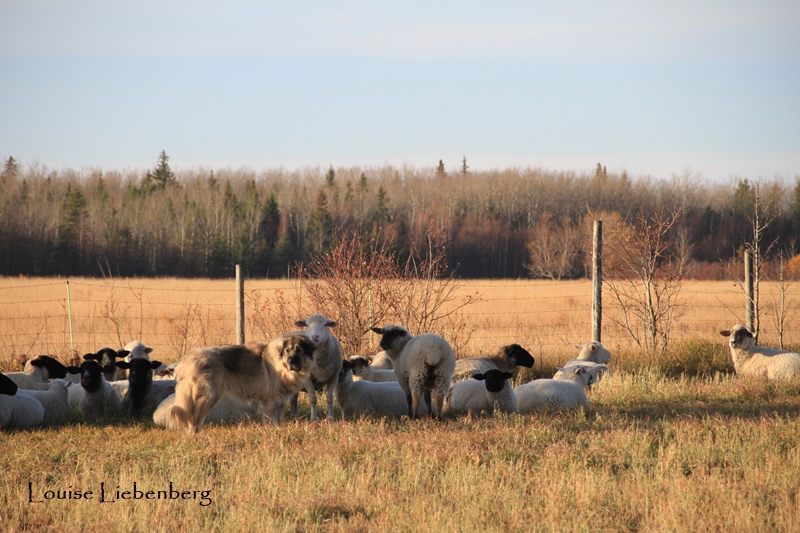
Correcting a young, strong willed dog for some naughty behaviour may be necessary, but you sure as hell, cannot force a soft  dog to go out and protect the herd when trouble comes calling.

Understanding the difference and knowing which dog has a problematic prey drive versus a strong willed protective drive, is key in knowing which dog is going to make the grade and which is not. 

I am a firm believer in the nature AND nurture theory, not nature versus nurture. It is about the whole package, the dogs need to be bred with good selection for the desirable traits, they need to be doing the job in order to be able to make the selection and those traits need to be nurtured in a manner where the dog can truly excel at its job.  


It is a fine line.

Saturday, 18 June 2016

Catch up


When spring rolls around the time to blog drops dramatically.
the days are longer and that means more to do outside.
The pastures need fence checking, and this year we need to build an entire fence on  some pastures.

The weather has gone from one extreme to the other. With a very dry and high fire risk, to torrential rains and even snow a few weeks back.
The dry weather caused very much concern, and now the rain has slowed all the fencing down, and we cannot get the cows moved to pasture due to the road ways being so muddy.

The spring time also means the wrap up of the 4-H year for the kids, so their achievement day shows and awards nights all needed wrapping up.

The kids did well at achievement day, Roy won with his steer the club and District Rate of Gain, and Sr District Showmanship, Jess did well with her heifer. Roy rocked his flock and ewe classes, and Jess rocked her ewe lamb, grooming and showmanship classes.


The kids are now preparing for their Summer Synergy week coming up in July.
This year, they had to make a marketing video project for Summer Synergy.

You can see their videos here, their videos had to be about Rural lifestyle, quality food production and or Farm Safety.


As for ranch  news,
the March/April lambs were weaned today and the ewes turned out on grass.
We culled heavily in the flock after lambing time, we got selected out all the original ewes we started with when we moved to Canada. These are good solid old ewes, and have been with us since the beginning. I can't help but feel a little sad to see them go, however they start to battle getting through the winter when they get older, so it is time for them to go.

Some more news, we have two new sarplaninac male pups here on the ranch.
One, Kushi, was gifted to us by a good shepherd friend in Macedonia.
When we visited Macedonia last year, we saw the sire and the dam in with their stock.
These are true, old line sheep dogs. I am excited to see how Kushi will grow out.

The other male ( who has no name yet), comes from a totally different line.
I have know this breeder for some time as I have a dog from one of his males already.
I was given the opportunity to take the only male from this litter.

They had a long journey here, first by road from Montenegro and the other from Macedonia, to Serbia and then on to Czech Republic, before boarding a flight to Calgary.
I did an up and down trip to go and collect the two boys.

A very big thank you to a long term friend Stepanka, for helping facilitate the import, transport, papers, flights and great care for the two pups before they arrived here.

So, a quick meet and greet of the two pups:


We wasted no time in letting them meet their future charges.


Other sarplaninac news is that we think and hope we are getting a litter from our Beli and Mali.
Beli will be 10  this fall, so we decided it was probably a now or never situation if we still wanted a litter of pup from him.
This will be Mali's first litter.
More news of this litter and all the details will follow soon.
Mali leading the way for the sheep during a down pour.
So, despite the lack of blogs, a lot of things have been happening here.
Come winter, I will have plenty of stories to share again.

Related Posts Plugin for WordPress, Blogger...