Showing posts with label Other LGD. Show all posts

Sunday, 9 August 2020

Do they have "it" or not?


This dog has it all, attentive, protective, and trustworthy. He did require some corrections while in his adolescent years, and never missed an opportunity to make go and visit some of the other ranch dogs. Except for those minor flaws, and his intense dislike for strange cats, this dog had “it” all.

Do they have "it" or not?
©Louise Liebenberg  June 2020
Written for The Shepherds Magazine

My friend Jill, from Northern California, asked me if I thought that livestock guardian dogs either have “it” or not. It is of course an interesting question to ponder. Before, I can delve into this, I think “it” needs to be defined. I am assuming Jill means the traits, character, and ability to be successful Livestock Guardian Dogs (LGD) without much involvement of the shepherd (beyond the normal facilitation in raising and bonding). The “it” refers to the part that the dog brings to the “table”, both in traits and character.

I do believe that some dogs do just have it. These dogs are solid, reliable, and trustworthy with the livestock right off the bat, with little to no additional guidance from the shepherd.  I also know that other dogs can be reliable and trustworthy but may require some more time and input from the shepherd. Finally, there are other LGD who are never trustworthy and no matter how much time and effort the shepherd puts into them, they just do not have what it takes to do the job. Some dogs can even be partially good, reliable in some circumstances and not in others, or effective some of the time. Even just the presence of the dogs, whether they are actively guarding or not, still has some deterring effects on predators. 

 Most of the researchers still use the three pillars laid out by the Coppinger’s to assess the effectiveness of LGD, namely are they trustworthy, attentive, and protective of the livestock? In a study of LGD in Georgia by Robin Riggs, he interviewed shepherds and documented 525 dogs (adults and juveniles). Some interesting numbers roll out from these studies. Respondents rated their dogs as good (61%) and partially good (22%). To fully understand the partially good one needs to understand that a dog can be attentive to the livestock and highly trustworthy, but can lack protectiveness, therefore “partially good”. Or, it might be trustworthy and protective, but because they are inattentive; for example, the dog is not always around the livestock when predators attack, this dog might be rated as partially good. Shepherds rated their dogs as good when they were attentive to livestock (51%), aggressive to predators (12%) and unafraid of wolves (7%).  Partially good dogs were considered; not attentive enough (38%), insufficiently protective (33%), or attentive but afraid of predators (19%). 
Respondents were asked about their training regime, 40% claimed their dogs learnt to do their job by themselves, 31% were raised with the flock and 25% claimed the dogs learnt what to do from the other dogs. Only 2 respondents claimed to  engage in specific actions to encourage attentiveness in their dogs by encouraging the dogs to accompany the flock or by feeding the dogs close to the livestock.
Five farms claimed their dogs were not good citing lack of attentiveness, fear of wolves, poor breeding, or failure to train properly. (Rigg Robin; Goldthorpe Garth; Popiashvilli Teimuraz and Sillero-Zubiri Claudio, 2017)
It is interesting to note that some respondents specifically noted that their failure to correctly train the dogs was a reason for them being “not good”. This certainly implies that some effort and work on behalf of the shepherd is required, and that it is not just a matter of the dog having it or not. 

In the Georgian study no actual figures were laid out for what percentage of shepherds felt that the dogs failed in their job, if respondents claimed 61% were good and 22% partially good, can one assume that  17% were not good? (Rigg Robin; Goldthorpe Garth; Popiashvilli Teimuraz and Sillero-Zubiri Claudio, 2017)

In a study in Portugal the numbers are a lot more optimistic. In a personal communication with Silvia Ribeiro, who works with Grupo Lobo in helping to place LGD with shepherds. The dogs are monitored and scored based on their effectiveness, trustworthiness, and protectiveness. Data is kept on all the dogs in their program.  It was found that about 6.9 % of the dogs evaluated were found to be unsuited for LGD work by their (initial) owners, however some of these dogs were transferred to other farms and were successfully integrated back to work. Ultimately, only about 2.5% of the dog evaluated were excluded completely as LGD.  The reasons cited for this were mostly behavioral problems, and in 80% of the cases related with lack of attentiveness (44.4%), trustworthiness (44.4%), or protectiveness (11.1%).  In the other 20% the motives mentioned by owners were related with damages to neighbor's gardens, killing of chickens, chasing cars, aggressiveness to other dogs, and fear of aggressiveness to people.
(Ribeiro Silvia; Guerra Ana and Petrucci-Fonseca Francisco, 2017)

Statistics on failure rates in LGD seems to vary, and seems directly tied to how invested the shepherds are in working with their dogs. A certain number of dogs do fail, despite being given every opportunity to be successful. “Not all pups are capable of becoming good livestock guardians, regardless of how they are raised”. (Coppinger R, 2001)

“Almost all pups in the present study showed some obnoxious behaviour towards sheep. Even the best dogs vigorously chased sheep when they first accompanied flocks to pasture at five months old. How shepherds responded to such behaviour was of great importance. Most disruptive behaviour can be corrected, given sufficient patience and a degree of tolerance (Sims and Dawydiak 1990:45-80, Coppinger 1992a). According to these authors, LGD behaviour can change substantially as dogs mature and a seemingly unsuccessful adolescent may still prove to be a good guardian.” (Rigg, 2004)

So, it is clear that some troubling behaviour is to be expected, however what happens with this troubling behaviour and how it is dealt with is perhaps more determining for the successful outcome for the LGD.
As Ribeiro states “I believe in most cases, in the right context and with the right owner (experienced/patient), dogs can be recovered. It seems sometimes it is just a question of lack of maturity, and with time they can outgrow those undesirable behaviors, especially if not reinforced.” (Personal Communication, 2020)
Rigg also reported that during the study in Georgia they often found the dogs away from the flocks, and the dogs were often absent during a predatory attack.   This indicates a lack of attentiveness in the adult dogs.  He recommends better rearing practices and starting this with younger pups to help improve attentiveness in the LGD.

When the sheep are well protected, the shepherd certainly can rest a whole lot better.

So, coming full circle back to the question Jill asked about whether LGD simply have it or not, the numbers and research suggests it is always a combination of nature and nature. For the dogs to be successful it does appear that a certain amount of work and facilitation is required by the shepherd. The shepherds and owners need to be invested in their dogs to achieve good success rates.  The Grupo Lobo dogs are monitored, shepherds are taught how to work with their dogs. In other regions manuals on the most successful way to raise and bond LGD have been written to help improve the  (perceived) success rate of LGD. There does seem to be a common thread in how to manage these “failures”, and that will be a great topic for a future article.

I do think some dogs are simply not cut out to be LGD, they just do not possess the right combination of traits needed for the job, either due to poor breeding, lack of selection, poor character or lack of guidance by the owner.   This is of course not unique to LGD, not every border collie can work a full day or have the innate abilities to work well. Even some border collies are only “partially good” and some have no desire to work livestock. 
Some dogs who show poor behaviour can be worked with or perhaps as they hit maturity they can settle down and become effective. I think a lot also depends on circumstances, someone on a few acres and low predator threat might be sooner content with how the dog is working than someone dealing with heavy predation. I think owner perception of the job a dog needs to do, is also determining in an assessment of how successful they are. Some folks are content when a dog just hangs out at the feeder with the sheep and other people want to see active guarding and preferably killed predators. I believe a dog who is inattentive or lacks protectiveness can still be somewhat useful. I think the hardest trait to deal with are dogs who not trustworthy with the livestock, in some instances direct work,  supervision and maturity can resolve that issue, but when dogs have the opportunity to  continue bad behaviour, I believe it changes something in their brain. It ignites the predatory response and once that is triggered, it is hard to change that behaviour. It is such a fine line for a canine to live and interact with a prey species, it is easy to understand that some are simply not cut out for that job. 

I believe those shepherds who have dealt with many LGD, do see sooner which dogs might not make the grade, it could be a feeling, or how the livestock respond to the dog  or early recognition of troubling behaviour. I know, I have had dogs who I have always felt were just not attentive to the livestock and later, this changed into more troubling behaviour resulting in untrustworthiness.  The key is recognizing troubling behaviour or even the circumstances that can lead to troubling behaviour sooner, will increase the success rate of “problem” LGD.

References

Ribeiro,Silvia; Guerra,Ana and Petrucci-Fonseca,Francisco. (2017). The Use of Livestock Guardian Dogs in North-Eastern Portugal: The Importance of Keeping the Tradition. Carnivore Damage Prevention News(15), 9-18.

Coppinger R, a. C. (2001). Dogs; a stratling new understanding of canine origin, behaviour and evolution. New York, USA: Scribner.

Rigg, R. (2004). The extent of predation on livestock by large carnivores in Slowakia and mitigating carnivore- human conflict using livestock guardian dogs. UK: University of Aberdeen.

Rigg, Robin; Goldthorpe, Garth; Popiashvilli, Teimuraz and Sillero-Zubiri, Claudio. (2017). Livestock Guardian Dogs in Georgia: A tradition in need of saving? Canivore Damage Prevention News(15), 19-27.

Silvia Ribeiro, personal communication. 

Friday, 1 September 2017

Policing ourselves


This article appeared in the Shepherds Magazine 
©Louise Liebenberg 2017


I am a firm believer that each group or organization needs to police its self. For example, I believe that ethical hunters should always report poachers and should ensure that poachers do not get a ‘free ride”. Similarly, I believe that the sheep organizations must police their own members when it comes to issues such as animal welfare or other industry concerns.  The actions of a few “bad ones” can have great ramifications to the entire industry, which could result in new laws, possible bans, more monitoring and public backlash. I further believe, that it is also vitally important to listen to the murmurs and comments of the public and, possibly even groups who are known activists, as you will hear what the concerns and issues are and what they are focussing on. Being aware of what the public finds concerning early on will allow time to either address, educate or explain the situation or possibly change questionable practices. So, by now you are probably wondering what this all has to do with livestock guardian dogs?

On many of the social media sites one can regular hear concerns about LGD use, some people are concerned about the large numbers of cross bred Pyrenees ( or other LGDs ) ending up in shelters, they are concerned about general welfare issues such as cold or snow ( campaigns to bring them all inside when the weather is cold), people are concerned about range dogs being forgotten after the grazing season,  others ( non dogs people) are concerned about aggressive dogs on public lands and some people are concerned that the USDA are testing super killer dogs in their research project, to name a few. Some concerns are legitimate, while others may be a little off track, but hearing them and acknowledging them is something we all need to do when it comes down to protecting our sheep industry and the dogs who protect our stock.

If we, as an industry, do not police ourselves on these issues, other organizations will step up and lobby for measures that might be detrimental to us. It is better to be proactive in these matters than wait until the use of LGD is banned. In a few European countries breed bans already exist, and quite a few of the LGD breeds are on these lists. In some areas, certain by-laws are already in place where no dogs can be outside in the cold or snow or no tethering is allowed, or a maximum number of dogs are allowed on the property. These laws are placed to ensure a better high welfare standard for the dogs, or to prevent human/ dog conflicts. For many ranchers who use LGD, these laws limit the way the LGD can be utilised or are so restrictive that it makes it working with these dogs impossible. It is imperative that we acknowledge these concerns and start working towards resolutions.

So, what can we do to ensure that decades down the road, we can still use LGD in their traditional way, living out with the sheep and protecting the livestock from predators?
We need to ensure that the guardian dogs working for us, have a high level of care and attention is paid to their welfare. The dogs need to be in a good physical condition, healthy and strong. If Joe Public goes hiking on a Sunday afternoon on public lands, the dogs he see’s and photographs should be healthy and fit. Old, sick, and injured dogs need to be cared for at home.  Perception is everything, if the public perceives the dogs are not well cared for, it reflects on the industry. Even though all of us know that most LGD will not utilise a shelter while out with the flock, it does not mean that we should not be offering some access to shelter.

A big concern on public lands is dog aggression towards hikers and bikers. Here education goes a long way. Sign post that sheep, shepherd and dogs are in the area, educate how to behave around the dogs, possible be prepared to move the flock to an area with less human traffic are ways to alert the public of the dogs and the role these dogs play in protecting our herds. I think a big part of this concern can also be mitigated through correct socialization of the dogs. LGD who are accustomed to being handled, who see people regularly and who are not fearful of people tend to behave calmer in situations where they meet strangers. Semi-feral dogs are fearful, the stand with their tail between their legs and bark excessively at strangers. They are unpredictable and nervous, which can escalate quickly to a bite situation with people who do not understand dogs. Dogs who are fearful of people, look like dogs who are beaten as they cower, are nervous, tail tucked under the belly and nervous when approached. The public might perceive abuse in such a situation.

 Semi feral dogs or dogs who are raised “hands off”, can also not be handled appropriately when it comes to veterinary treatments, or simply leashing them if the situation arises, transporting these dogs is often a huge issue. This situation is concerning from both a animal welfare and public safety point of view. It is time to put the “never touch the LGDs” myth to bed, and we need to start rearing LGD pups in a way that is more socially appropriate, better for the rancher, the dog, and the public.

We need to be cognizant of the fact that there are many unwanted LGD crosses ending up in shelters. We need to ensure our non-breeding working dogs are spayed or neutered to prevent accidental breeding’s between the herding (or, any other breed) and the LGD. The world does not need more unwanted pups. We need to ensure that we do our part and not add to the problem by having litters of pups that have no homes.  Perhaps, it is an idea for local sheep groups to approach a veterinarian and see if they could negotiate group rates for working LGD spay and neuters. We need to focus on breeding the best LGD to the best, and ensure that good working homes are available for these pups. We need to be as vigilant in breeding our LGD as we are in breeding our livestock.


It is always makes the headline and social media, when LGD are forgotten on the range. It is reports such as this that paints our industry in a bad light. I get that LGD sometimes roam, and I get that some disappear and reappear later, however we need to try to the best of our abilities to find any lost dogs, we need to try to get them back. Micro-chipping, or even a contact number tattooed on the dog, or a name and phone number on the collar of the dog will help with this. 

Having dogs who are human social will certainly help when trying to locate a missing dog.
We need to dispel misinformation in a professional way, if some environmental groups of people are having concerns that the USDA are breeding a breed of super wildlife killing dogs, we need educate and inform them what is the reality. Even though the issue may seem absurd, these rumors soon have a life of their own. Giving out clear, easy to understand, factual information, will help relieve some of these concerns, rather than dismissing them as garbage.

So, that brings me back to the beginning, as a sheep rancher or an industry organization, we must listen and acknowledge concerns people have with regards to the welfare of our sheep and our working dogs (herding and livestock protection), we need to police ourselves and do all we can to prevent topics of concern becoming major issues down the road. We need to aspire to higher welfare standards for our working dogs, better rearing practices, appropriate socialization, and more education to the public, if we don’t do this, other groups will lobby governments for more restrictive laws, and more controls and this maybe be so restrictive that using LGD may becomes impossible.

Tuesday, 29 November 2016

Part 4: Portugal and the cows


I have mentioned before that the system with the cows is similar to the sheep and goats.
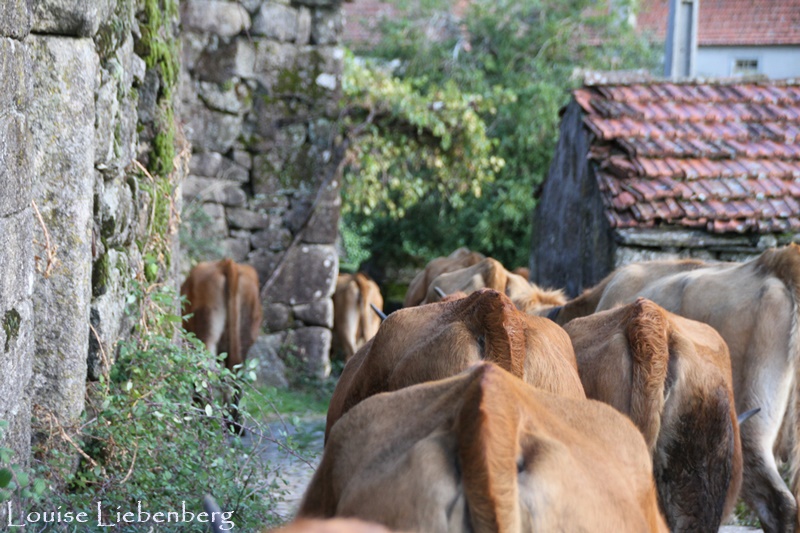
The cows are let out in the morning, and are brought to the mountains where they spend the day grazing. In the evening the cows either head home on their own or are gathered by the owner.

We had supper with José Ferreira, the owner of these cows, , and the next morning we could follow him and his cows to the mountain.

The cows spend the days mostly alone in the mountains. All the cows have bells, and each cow has a different sounding bell/s. The owner can recognize each cow by the sound of the bell.
The bells helps the owner locate the cows in the mountains and can hear if one wonders off. In some areas the cows are shepherded. There are some jokes about whether the bells are like a dinner bell to the wolves


Wolves certainly target new born calves, the traditional breeds of Portuguese cows are smaller type and the calves and younger cattle are  vulnerable. These cattle are also super docile. The do have horns and they can use them to protect themselves, but these cows are not like some of our wild rangy cows we have here.

Some of the Portuguese ranchers have found that the imported breeds have more issues with wolf predation, as they are not as suited to the environment as local breeds.

We spent the morning following the cows through the village to the mountains, talking about the issues they are facing.
It was quite the walk between the houses, past the terraces, climbing narrow stairways and getting the odd wayward cow back on track.

Good mornings:


Leaving the yard.


Once through the village the cows head into the mountains to graze for the day.


This man has lost a few dogs due to poisoning, right now he has a new younger dogs, who is staying cak in the village to "bond" more to the calves at home, before being allowed into the mountains with the cow herd.
This is the new young estrela dog, still in the bonding stage with the cows.
This dog was part of the Medwolf project dogs.


Due to the poising issues, both dogs are still staying in the cattle yard.


In the local coffee shop, on the notice board was a poster hanging up for an event in town.
 a good opportunity to educate people about the use of LGD with cattle.


Once the cows were away, we headed back to yard. It was a wonderful opportunity to talks to José  about his cows, his dogs and the situation with wolves in Portugal.

As fellow cattle people I was also interested to learn about the business side to his operation.
His primary business is to sell veal calves from this Portuguese breed. So, the cows calve and stay indoors for a few weeks. After about 3 weeks, the cows join the herd to go and graze and the calf stays behind.
Initially, the cow wants to return back to her calf but they bring her back to the mountain. If she is very persistent in coming back, they will let her return home, but she will not be allowed to go to her calf until the time the herd returns, within a few days she has the system figured and will stay and graze. She is reunited with the calf for the night. By keeping these calves home, they are less vulnerable to depredation.


The calves are small, and when old enough to go for meat production they might weigh 250-300 Kgs live weight. They are fed when the cows are away at night and allowed to drink milk at night.
The calves are sold for meat production and some heifers are returned as replacement heifers and others sold as breeding stock. The longevity of these cows is long, so they do not have to replace the heifers very often.
These farmers get various European Union subsidies, for maintaining the landscape, as well as  keeping these local Portuguese breeds. The subsidies that many of these farmers receive are the financial backbone of their operations.


José, is enthusiastic about utilizing the guardian dogs, but the problems with lost dogs is a big issue. He is willing and motivated to find solutions for living with the wolves.
He was also one of the speakers at the meeting for livestock keepers.


A few short  clips when the cows start heading out in the morning.


Monday, 14 November 2016

Portugal Part 2, A sweet Estrela and his goats


Planning to see the shepherds is really an early morning,
or late evening endeavor.
Once the shepherds leave for the mountains for the day, it is hard to find them.
The best time to meet them is when they are leaving the village to go grazing or returning back in the evening.

The scenery on the drive to our first visit was incredible, and I am in awe of how beautiful and rugged this part of Portugal is.


The beautiful mountains, the quaint villages and the terraced gardens appealed to me. The stunning  variety of plants made me realize how limited and somewhat bland, our cold climate really is.  


The drive to our first goat herd was a treat in itself.
Stopping on the road, the goats were barely visible between the rocks, ferns and other plants.


The slightly nervous bark of a young guardian dog echoed against the rocks.


The dog stayed at a distance, overseeing us climbing our way towards the shepherd. From his demeanor and the sound of the bark, I could make out that this was a young dog.
A bit unsure of us and sticking tight with his goats.

He climbed up on a rock to better watch what we were doing, he settled down and moved a small distance away.


The expression of the dog softened when the shepherd spoke to him, a slow wag of his tail indicated that this young dog was happier now,
 a little less concerned about our presence.


This dog is a short coated Estrela, given to the young owner through the Medwolf project.
 He was tightly bonded to the goats and did not approach us.
 His owner hiked further up the mountain to go and collect the dog so that we could meet him.
Coaxing him down to us, the owner assuring us that he was friendly.
The dog was not aggressive, just unsure.
He was happy to head back to the goats once the owner let go of his collar.


The owner mentioned to Silvia, that this young dog has been seen chasing off wolves and that he felt it would be good to get another dog to help this one. The only catch was,  he really insisted that a another male would be preferable.

During my visits, I would hear that this more often, the shepherds only want males and really could not be bothered with a female dog.

Every shepherd we visited,and around every village, one could see the small knee high hunting dogs. The Podengo is a traditional Portuguese hunting dog.
 In the years when wolves were almost extirpated, the shepherds only took the little hunting dogs with them while grazing. There was no need to protect the livestock, as wolves were not a threat. The little hunting dogs were companions to the shepherds and provided perhaps, a meal or two.


With the protection of the wolf and it expanding further into Portugal,  more and more conflicts arose between the livestock and the predators. These hunting dogs were no match for the wolves, they did not stay with the herds and were often off hunting on their own.
The use of the traditional LGD was almost lost, and the culture of working with these dogs was forgotten.
It was a challenge to even find good working dogs.

The Medwolf project has been giving LGD to shepherds for over 20 years in an attempt to help mitigate these conflicts. The project would donate the dog, and provide food and veterinary care for the dog for its first year. The Project monitors the dogs and do regular checks on these dogs, providing help and advise to the shepherds where needed.


Many of the shepherds are somewhat skeptical to use these dogs, fearing that the big dogs would be unable to work in the mountains, or even, if they would succeed in keeping the wolves at bay. It is often the younger generation farmers who are now looking for, and embracing solutions, and are willing to work with these projects to utilize LGD.


It  is perhaps, the rise of the wolf that has saved many of the traditional livestock guardian dog breeds from extinction. Without the wolf, there would be no need for the sheepdog, and the tradition and culture of the shepherd and his dog would perhaps be lost forever.

Tuesday, 22 December 2015

Meco update

It has been 4 weeks since Meco had his injury to his neck and ear.

He has had 2 surgeries on it, and I am happy to say that the healing is going very well.
When the vet tried to re-attach the ear, they did not manage to restore all the blood flow back to the ear, resulting in part of the ear dying off.
Once the hair grows back on his neck and head, the smaller ear will be the only visible sign of this injury.
It looks like he has a semi traditional, sarplaninac one ear crop.

His spirits are high, he is playful, runs around and loves our daily walks.
He enjoys the visits to the collies and the chickens,
and he even went to visit the livestock today.

He has indicated that he is ready to move back to the stock;
 by escaping from the heated recovery barn, climbing over the kennel panels, ripping out the door,  and being resistant when I want to place him back in the barn.
He wants to be out and about.
He will move back to the stock once he has completed his last round of medication.


I am happy he is making such a fantastic recovery;
 he is young, healthy and resilient,
with good vet care,  our daily care and of course  antibiotics,
have all helped speed up his recovery.

Thursday, 22 October 2015

Guard Llama's

Do Llamas really work as flock guardians? 


Let me start this blog off with a big “I DON’T KNOW”.
We do not use llamas for our flock protection.

I have done a fair amount of reading on them and the little research  I have done,
 does indicate they do play a role in keeping sheep safe.

I have read reports that some llamas  are effective, and I have read reports saying they are marginally effective to totally ineffective.
I think the jury is still out on this one.

This website:  http://buffalocreekfarmandcreamery.com/farm_llamawhychoose.html  states:
 “Over half of the llamas guarding sheep are 100% effective. An additional 40-45% of the guard llamas are highly effective while only 5-10% of the guards were ineffective.
Large predators such as bears and mountain lions may be too large or aggressive for the llamas. However, llamas have been known to alert herders of large predator attacks.
No training or previous association with sheep or goats is required for the llama to be an effective guard.
Any age llama, except those under one year, have been proven to be effective at the time of initial introduction.
Intact males are effective guards along with geldings. Females are also very aggressive toward canines. However, there have not been many studies using only female llamas.
One llama per flock is more effective than two or more llamas. Several llamas tend to bond to one another rather than with the sheep or goats and may ignore the flock.

Most reports do state that a number of conditions need to apply,
for llamas to be effective guardians, things like smaller flocks, open terrain, small predators, low predator pressure, only one llama per flock etc.

In a study done in 2000 (https://www.aphis.usda.gov/wildlife_damage/nwrc/publications/00pubs/00-45.pdf),
the conclusions indicated that llamas do provide a certain amount of protection to sheep flocks. primarily in the first year.

After reading  the various reports, I was curious to see some llamas in action.
 No better place to look than in massive crowd sharing sites such as You Tube.

I found a few videos, some very unclear, of llamas working,
two of these videos caught my eye.
One from the Swiss folks (https://youtu.be/SX5GvhIF2j4)  testing Llamas in the Alps
 and another of a llama protecting a week old calf from some pet dogs (https://youtu.be/Was388eiNl0

Watching the llama with the calf, I felt that the llama was showing protective behavior, similarly to how it would protect its own young,
 however in reality,
I think that a momma cow would actually have been more effective.

The llama did stomp and chase somewhat.
I can see that a pack of coyotes or even a few determined pet dogs,
would easily overwhelm the llama.
  The Swiss video starts off by saying that none of the llamas had yet encountered a wolf, and they were not sure if they would be effective.  They thought, that  llamas may only be really effective on small (20-30 sheep) operations, but no conclusions yet, as they were still being tested.

In Alberta, it is actually fairly common for sheep ranches to have a llama or two in with the sheep as protection, often combined with one or two livestock guardian dogs.
I have spoken to people who say that the llamas do seem to be effective, until serious predation sets in and then the llama is merely, another prey animal.

I often wonder how things come to be?
 Nowhere, in the traditional livestock guardian dog countries does one see people using llamas or other camelids for livestock protection.
How did it happen that llamas were being promoted to be used as guardian animals?
Perhaps, long time ago someone had a llama, that chased a pet dog away from the sheep,
the person saw this and decided to promote llamas as guardian animals for sheep?
I don't know.
 But, it does seem strange that one would use a prey animal to guard other prey animals.
It is undeniable that a llama can bond to the sheep and will place itself in between the sheep and the predator in some cases,
 just as LGD do , and  of course most mother animals will do.
They do charge and stomp at canines,
but how effective is, this if a serious predator attack occurs?

All prey animals have similar responses when encountering a predator it is flight or fight. If the opportunity arises to flee from a predator, then most prey animals will.
If however, they are cornered and trapped, or protecting young, the response is to stand their ground and fight.
For a sheep it would mean a display of some foot stomping, perhaps a charge and a head butt.
The do not have much more in their arsenal against predators.
Their safety is really the flock.
A llama does not have too much in its arsenal either, it can stomp, kick, spit and charge.
The average ewe weighs about 160-200 lbs, a mature llama weighs between 286- 440 lbs, and other than its feet, has not "weapons" as such.
Alpaca or llama, some people advocate using alpacas as guardian animals.

When it comes to dealing with large predators, the odds against a llama succeeding becomes smaller. If ones looks at what wolves actually eat,
and what they are faced with,
then a llama is no match.

Moose,  and elk are some of the traditional prey species for wolves. The average moose weighs 1000lbs, can be as high as 2 meters at the shoulder ( 6.5 feet) has a kick that could send a wolf to never-never land, the males has an antler set that are deadly, they can stomp and charge,
and to top it all off,
 a momma moose has a bad attitude. 


An elk is incredibly fast (faster than any llama or sheep), weighs about 800 lbs, stands 1.5 m at the shoulder, has  daggers for horns ( the males), can kick, stomp, and of course charge with those antlers,
and yet,
 they all fall prey to wolves.


These animals are way better equipped to deal with predators than any llama, so it would seem reasonable to assume that a llama may not be able to protect a flock of sheep from bigger and very determined predators.

In fact, perhaps placing a momma cow with a young calf in with the sheep flock, may provide even more protection to the sheep, than a llama.
A cow will run down, stomp on, kick, toss in the air, mash down with its head, paw, pierce with its horns and charge at a perceived threat,
with 1500 lbs of mad momma behind it,
she becomes quite the protector,
and yet, we rarely hear of people using cows to provide protection to sheep flocks.

I do believe that because of the added height and size of a llama, they do have a role as a sentry. They are hyper aware, can see far, have big flexible ears
 and in that role,
 I believe that can be effective.

As llamas are not native to North America or Europe, I can imagine that a wolf encountering a llama for the first time would be flabbergasted. They would not know what to make of this animal, would be cautious to approach and would be highly suspicious of this strange animal.

Alpaca

A wolf or coyote may not even recognize a llama as food, simply as it has no genetic memory or imprinting telling it, that it is food.
So, the llama certainly has the element of surprise in its favor.

A friend of mine, who does not use guardian dogs, but has a llama and donkey has been suffering regular predator attacks on her sheep flock.  Almost daily, she losses a sheep. I asked her how the donkey and llama were doing and her reply was that they were not working. The donkey stands at the gate and the llama does nothing. 

I have other friends, who breed show llamas, they use guardian dogs to protect the llamas from predators.
Before, we moved to Canada, we asked fellow sheep ranchers if they felt llamas were effective, some said yes, but only with smaller flocks in open areas,
others said no they were not, but had them anyway, just in case..

It seems that people feel llamas are effective,
until the day they are ineffective against serious predators.

I am all for, whatever works.
However, I  do feel that ranchers deciding to use guard llamas,
need to have a realistic expectations of what these animals can do.

Even, in the LGD world, it is well accepted that you need at least 2-3 dogs, and preferably a few more, to have sufficient protection for a flock.
Expecting a single llama, that has no real defense mechanisms, to protect a flock of sheep against predators is perhaps pushing the expectation limit too far.

Understanding too,
that these animals may be vulnerable to predation themselves.
Putting a single llama out with a flock is putting the llama at a similar risk as the sheep it is suppose to protect..
Mini donkeys and  alpacas fall into the same category.

As a friend says; " using food to protect food is not logical".

I suppose it is like having a chocolate bar protecting the apple pie,
the chocolate may be a temporary diversion,
 but it is no deterrent if someone really wants to eat the apple pie.

So, back to llamas, the little research out there, does indicate that they may play a role, perhaps only a short term role against smaller predators in specific circumstances.
 I am all for using as many tactics as possible to prevent depredation as once the cycle sets in,
it is very difficult to stop.


So, even if they can only provide an ounce of protection, it is always more, than doing nothing!
Even, if they do not work for every situation,
they are still look pretty awesome in among a flock of sheep!

Using a combination of llama, or donkey with guardian dogs,
may provide added protection.
So, it would seem to me that llamas are definitely an option in small flocks with low predator loads,  for people who do not like or want to work with dogs or  for people who understand the limitations that a prey animal has when dealing with serious predators.
They are great sentry animals and will certainly offer some form of minimal protection, however in larger flocks, grazing bushy areas and plentiful predators, then I think, the only serious guardian animals, are dogs.

You may need to fight fire with fire.

Guardian dog on a sheep ranch in southern Alberta.

Related Posts Plugin for WordPress, Blogger...