Showing posts with label feeding. Show all posts

Tuesday, 25 June 2019

Traditional LGD Food


LGD in Macedonia just leaves the communal feed trough that is filled with the staple for shepherding dogs, a bread or porridge, mixed with scraps and either milk or whey.


Traditional LGD food.

©Louise Liebenberg  March 2019

Written for The Shepherds Magazine

We are slowly coming out of a very long and brutal two-month winter period and that is a big relief. We have had temperatures for weeks between minus 22 and minus 40 Fahrenheit, with just the odd day of reprieve here and there.  Were we live (in the sub-arctic zone), we are used to severe cold, but normally it only lasts a week or so and then it warms up a bit, this last winter was a long haul!  The extreme cold certainly took a toll on all the animals. We have used much more feed (hay and grain) than originally anticipated to both the cattle and sheep, to help them through this cold. The “outside” ewes who are only due to lamb in spring, seemed to have maintained their condition well with their winter woollies. The ewes that lambed in December are in the barn, we can see that the cold was a little harder on the lamb with their growth rate a little behind than other years.  The livestock guardian dogs (LGDs) certainly spend more time hunkered down between the sheep or snuggled in a straw bale. They rarely use the dog houses, preferring the warmth and companionship of the sheep and cattle.  One of our seven-month-old pups really learnt to bed down with the replacement heifers. Cold weather certainly does help with the whole bonding process.

With very cold weather, I like to feed the LGDs twice a day, to ensure they have enough energy to keep warm and maintain condition. I will go from once-a-day feeding, to twice a day, morning and evening. I notice a dramatic increase in the amount of food the dogs will consume when it is so frigid. The amount I feed will almost double.  While chatting to a friend and sheep rancher colleague, she mentioned that in this cold she decided to feed her dogs some “YAL” as she liked the dogs to have a nice “warm belly full of mush”. I am not really a dog food “foodie”, and when folks start talking about dog foods as though they are talking abut human health products, things like this usually tend to go in one ear and out the other. The word “YAL” got my attention, I knew what it was but was not something I had considered feeding our dogs but right now, this sounded like the perfect solution to help keep the dogs warm and increase their food intake. It is a challenge to get enough liquid into the dogs, as any liquid freezes instantly. By feeding a stew, rather than frozen meat or kibble, I would be able to increase the liquid intake for the dogs.  I decided to give YAL a try.

I rummaged around in my pantry and found a bag of quick oats, boiled it up, added some bacon grease and a pinch of salt. I made a big pot and fed this to the dogs along with their regular food of kibble and meat. The dogs wolfed it down. In a relatively easy manner, the dogs got a nice big bowl of warm food and plenty of liquid, and surprisingly, they seemed to really like it. I was concerned they would turn their noses up and not eat it, which self respecting dog would eat oat porridge?

This got me thinking more about traditional food for LGD. I remember seeing the dogs in Macedonia eating at a trough that had a bread and whey mix in it.  After doing a little more research and extra reading, it appears that most shepherding cultures across Europe, do feed a grain-based diet to the LGDs, supplemented with milk, whey, meat scraps and anything else that was left over. The dogs would get the afterbirths, dead lambs and other table scraps that were available. In some places, the dogs are fed a porridge type food, and in others a “bread” was made for the dogs. 


The communal feeding trough for the livestock guardian dogs. In the trough is bread that is usually mixed with water, milk or whey. This forms the basic diet for the LGD.
Güvener Işik writes extensively in his book “The Dogs on Anatolia” about the traditional food the dogs are fed in Turkey. “Yal” is a porridge of broken or flaked grain (mostly barley, oats, wheat, corn or in some cases bran). If only the flour version of those grains is available, then that is what is used. It is boiled with a pinch of salt and this forms the basis.  Added to this mix is often the left-over whey from the cheese making process, milk, yogurt and leftover table scraps such as vegetables and oil.  In North America we tend to forget those most of the shepherding cultures primarily utilize sheep for milk and cheese making. Every shepherding family makes a sheep cheese and the whey left from this process is added to the dog food. Whey fortifies the grain-based diet of the dogs, and due to its protein structure, a great addition to the Yal. Whey is an interesting protein source as it is neither meat based not plant based but comes from dairy. Protein, simply explained, is made up of various essential and non-essential amino acids.  Essential amino acids are those that dogs cannot self produce and needs to be consumed from an external source. Whey has one of the highest ratings for protein, when comparing common protein sources (chicken, beef, soy etc.) according to their quality, this includes how “bio-available” it is to the dog and how many of the essential amino acids are in the protein source.  (William Misner, n.d.)  It is clear to see why a basic diet of boiled grains, and whey formed a traditional dog food where both grains, and whey are readily available. 

In some areas a bread is baked as dog food.  In Spain the dogs are fed a rye bread called “perruna”. The rye bread is hard, black and weighs about 750 grams, it is easy to transport into the mountains and taken while grazing. Milk is added to the bread and this formed the basic diet.  Dating back to the 18th Century, the shepherds and their dogs ate the same portion of food as the “La Mesta” rules determined. La Mesta was a powerful association of sheep ranchers who determined that the mastines were protected by law. These wolf fighting dogs were highly revered. The LA Mesta decided that the dogs should eat the same portion and bread as the shepherds themselves, for the brave work they do.

In Romania, the traditional food is very similar to the Yal the Turks feed. It is a mixture of “Zer” (whey) and a corn-based porridge called “Mamaliga”. Depending on what is available, the dogs would get mamaliga or bread, and zer. In a large pot the zer, mamaliga, some veggies and meat scraps are boiled into a soup/stew for the dogs.  Butcher scraps like the head of the animal and large bones were given to the dogs to eat as extra.

In Macedonia, we saw first hand how important cheese making is, every family makes its own cheese (a type of feta). The dogs are fed a mixture of bread and whey, along with dead lambs, afterbirths anything else the shepherds could spare, and even small game the dogs could hunt. I know, our dogs happily hunt mice to add to their diet!


Milking sheep to make cheese is a primary use for sheep in most shepherding cultures in Europe. The milk is used to make a feta type of cheese and the dogs get any left-over milk, whey, yogurt added to their basic diet. This Macedonian shepherd quickly milks an ewe during evening chores.

According to Güvener Işik, feeding a grain-based porridge or bread will result in pups growing slower and therefore will have a stronger skeletal system.  He mentions that Anatolians were selected for and evolved to being able to thrive on low calorie and low protein diets. As he states; “Overfeeding an Anatolian is abusing what the Anatolian inherited from its ancestors.”. He makes an interesting statement regarding feed and energy levels in dogs, stating that low energy food helps to scale the dogs’ energy level down to that of the sheep. We know with horses, one can feed them “hot” resulting in a high energy horse, so perhaps this is true for dogs as well?  It would be interesting to see if some high energy/naughty dogs would calm down if fed a lower energy and lower protein diet.

One thing I can conclude, that in the brutal cold we had, our dogs really seemed to appreciate having a warm, belly full of porridge. 


The staple food for LGDs, bread or porridge and scraps. In these areas the shepherds cannot access nor afford expensive industrially made kibble. The dogs eat what the people have on hand.

Reference


Işik, G. (2002). The Sheepdogs of Anatolia. Ankara: Library of Congress.
William Misner. (n.d.). Retrieved from https://www.hammernutrition.com/: https://www.hammernutrition.com/knowledge/endurance-library/protein-debate-which-protein-is-best/


Friday, 3 November 2017

Feeding LGD

This article appeared in the July edition of the  Shepherds Magazine 
©Louise Liebenberg 2017


Feeding a pack of livestock guardian dogs can be expensive, however, there are several ways to help reduce the overall feeding costs. In this article, I will discuss some of the things we do to help maintain quality food to the dogs at a cost-effective rate. I understand that laws and situations are different, and this may not be a viable option for everyone.

Feeding dogs is always regarded as a “hot topic” among dog breeders and dog owners. Some swear by certain brands, others by raw feeding, yet others by “traditional” foods that dogs would eat in their land of origin. I have the simple belief to feed what we have, what is available, the best we can economically afford, and as naturally possible. Fads, great marketing, or clever packaging of big brand dog food does not influence me. In fact, I am averse to these gimmicks in the dog food industry. I like to keep it simple and affordable.
We are feeding 8 Sarplaninac LGDs and a few border collies at any one time, that is well over 1200 lbs of dog every day. Our dogs go through a 40-lb bag of dog food every couple of days. A reasonable quality dog kibble is quite expensive, and keeping the dogs well fed is quite a big cost.  Our dogs are fed primarily a raw diet including meat, bones, offal, and eggs, if raw is not available or inconvenient to feed, then the dogs get kibble. We are not “dog foodies”, our dogs eat what we have. We have never had any issues with the dogs switching between dog food brands, or between going from raw to kibble.

We have a few avenues for acquiring meat for the dogs, we have a good relationship with a local butcher who will provide us with meat scraps, bones, and other waste from butchering (things like liver, kidneys etc.). A lot of this waste is fat, which we either freeze and save for the colder winter months, or feed alongside some kibble. Excess fat, is disposed of through composting.

Our main source of meat for the dogs is through the feeding of cull animals from our own ranch.  We have made the business decision not to sell all our cull ewes and rams, instead we will process some of them ourselves into our own dog food. In this way, we can butcher a cull animal when we need it, and do not need to be concerned with storage or freezing.

We live about four hours away from the closest auction market, shipping cull ewes has been an expense to us due to the distance to our markets, time to drive them there, commission fees and the low value that these animals make on the market. It makes more sense to process them into our own dog food than ship them. Not only does it make economical sense for us to utilise these animals ourselves, it is also perhaps a better welfare decision for the culls, who do not have to endure long travel times and the stress of auction markets before butchering.
We will also process our own cull cows who cannot be shipped due to transportation and welfare reasons. We are often called by neighbouring cattle ranchers who have such a cow to come and process the animal., these cows are often given to us for free. A cow can feed a pack of LGD for quite some time.


We are lucky to live in an area (Northern Alberta, Canada) where we have very cold winters that last for 6-7 months of the year. This helps to ensures that all the meat we process, remains in a frozen state, allowing us to preserve it for the dogs without having to have a whole lot of freezers.
Our method for butchering is simple, after freezing the carcass, (this happens naturally outside in the winter), the entire animal is cut into large chucks, we do not skin or gut the animal, and simply make big chunks which we feed in frozen form to the dogs.
Some ranchers are concerned that once LGDs “taste blood” or eat the animals they are supposed to be protecting, they will go rogue and will not be reliable as LGDs any more.  We have never experienced this type of behaviour in any of our dogs. The dogs can clearly distinguish between the live animals they protect and chucks of frozen meat as food. In Macedonia, we saw shepherds feeding fresh dead lambs, cut into pieces to their dogs and none of these dogs attacked the sheep they were protecting. Many of the shepherd’s dogs lived on a basic diet of bread and water, sometimes supplemented with whey from cheesemaking or some milk. Any protein the dogs received was primarily from dead livestock or afterbirths. The dead stock was utilised to feed the dogs.

We do not allow our dogs to simply “help themselves” to any dead livestock, we do remove the carcasses and if the animal is freshly dead, we may process this meat too. We have found that our dogs will protect a dead sheep in the field from predators, ravens, and other scavengers, and then when cut up and offered as a meal a few weeks later, will willingly eat it then. There are a few things we do to ensure that a young dog understands the boundaries of what can be eaten and what not; we will not allow a young dog to eat still born lambs, we do remove deadstock as soon as we can, we reprimand a young dog if it starts to chew on a carcass in the field ( we like to investigate a carcass to understand what the animal died from), we like to portion and feed the animals frozen chunks rather than whole carcasses.

There are times when we do feed kibble, primarily in the summer when it is difficult to preserve the meat.  Our dogs are flexible, and they eat what they are offered, and they do not experience any stomach upsets going from kibble to raw meat. Feeding kibble to the dogs in among hundreds of sheep can be challenging, simply because some of the ewes really seem to like dog food. Feeding kibble often requires us to feed the dogs separately to avoid the sheep trying to bully the dogs for the kibble, we do not have this issue when feeding raw.
We raise laying hens and will also supplement the kibble with an egg or two.
Our dogs are healthy, fit, and energetic, have no allergies, have great coats and strong clean teeth, and are never ill.  I feed to need. If the dogs are working hard, or the weather is wicked, then the dogs get more. I like to keep the dogs well fed, and in good working condition.
Seeing the dogs enjoying a healthy meal of mutton or beef, knowing we have made the best economic decision for feeding our dogs, made a humane choice for the cull animal, and are feeding a high quality meal to the dogs, makes feeding this way a good choice for our ranch.

Saturday, 23 January 2016

Feeding buddies


While the Eastern USA got slammed by a massive storm,
for us it was business as usual.
We can handle snow and lots of it.
It does slow us down somewhat,
 but thanks to some mechanization all the sheep and cows get fed.


While out on the tractor feeding; I often see an opportunity to open the door and snap some pictures with my cell phone of the  LGD doing their job.


Shara is my cattle feed buddy.
When she sees me heading out with the tractor to feed the cows she is always delighted to go ahead and clear the way of any potential problems.

(and, yes I know the window needs washing..)

While I am cutting twine off the bales, Shara takes the time to check every thing out. She is the speck at the back of the cows.


On the look out for whatever may be lurking out in the bush:

Then it was time to move on to the sheep for their feeding.
After, processing some bales,
and filling up the grain feeder,
the sheep were ready to settle in for some eating.
Vuk, heads back out to the ewes once I was done feeding.


The dogs know their job, and every single day we trust that they will do their best to ensure the livestock are safe.
They are dependable, they are hardworking and it is a great feeling to know that the stock are safe under the vigilant watch of the dogs.

Visiting with the dogs, while out doing chores is a highlight of my day,
every day.


Monday, 8 December 2014

Brain Freeze part 2


Chrissy, commented  on my last post about the brain freeze:

"C'mon, you seriously don't provide some sort of liquid water to all of your animals? Creek, pond, anything?"

I would like to elaborate on this comment.


We live in what is called a Sub Arctic Climate.
Our winters, if we are lucky last for 5-6 months,
if unlucky we can see up to 8 months of cold and snow.
We have abundant snow during winter.


Normal 4ft field fence.

We have experienced temperatures as low as, -52.2C, that is -62F.
The temperatures rarely go above freezing point during the winter.

All lakes, ponds, pools, creeks and rivers freeze over.
The ice thickness can vary from 1 - 5 feet thick on lakes.
We build ice fishing villages on the lakes, drive our one ton pick ups on the lakes and even make highways over frozen lakes to transport big heavy oilfield equipment further north.

No where, on the landscape is flowing/liquid water. All wildlife has to survive on snow during our winters.

Some of the areas, where our animals are fed in the winter, only have water pools available in the summer,
Once these freeze, the stock transitions to snow.

We have never noticed any disadvantage to them eating snow as a water source.
We have noticed that the animals prefer to eat snow than walk to a heated stock waterer.
At the start of winter, we do chop holes in the ice of ponds to allow the stock to drink until sufficient snow is available.

We do move our animals as soon as they calve or lamb to an area that does have access to liquid water, through heated stock-waterers.
Any animals that are compromised in any way, weaker, thinner, too young are moved to the barn where they have access to water.
Animals, who are on a high dry matter diet ( high grain content) also are in areas where water is available.

Our dogs are offered liquid water, however as winter progresses they stop entirely with drinking liquid water, they only want to eat snow.
Also with the dogs, should any be injured, weak, or compromised, these dogs are also placed in our barn, where they have access to water in a liquid form.


Of course, in the summer the animals have access to liquid water, or when the snow melts and none is available for the stock, we provide water for them.

There have been numerous tests/research done on whether or not,
 stock should and can be watered on snow.


Here are some links and some conclusions:

CONCLUSION
Without any apparent stress, dry pregnant ewes and
beef cows can use clean snow as their sole source of
water. This watering alternative may be used for an
extended period of time or when there is a disruption
of the normal winter water supply. Clean snow is a
safe and economical option as a source of water for
Ontario sheep flocks and beef cow herds.
http://www.omafra.gov.on.ca/english/livestock/beef/facts/09-065.pdf


Conclusions
• Research shows that snow can be the sole source of water
for cattle without affecting performance negatively.
• Maintaining the health and welfare of snow fed cattle
should be a top priority.
• It is essential that snow be available in sufficient quantity
and in a form that is easily accessible by cattle.
• Management practices must be in place to ensure good
nutrition at all times. A backup watering plan is also
essential to deal with the scenario of snow becoming
unavailable at any time throughout the winter

Snow as a Water Source


  • After a short adaptation period, pregnant beef cows will consume snow in amounts equivalent to the water intake of cows receiving liquid water. Through extensive testing in the early 1980's, the University of Alberta found insignificant differences in cow performance or body stress levels when asked to eat snow as their sole water source.
  • Wintering beef cows are able to consume snow as their sole water source given that the snow is in a form that the cows can easily eat. The snow must be soft and friable so that the cows can lick a significant quantity into their mouths for melting.
  • Once cows are used to consuming snow as their sole water source, they will consume small amounts of snow throughout the day during their free time. Cows can be seen licking snow before, during and after their primary feeding times.
  • Although it takes ten times the amount of energy to melt a gram of snow from it's solid state to it's liquid state compared to heating the similar quantity of a liquid one degree Celsius, the key to energy use difference is found in the rate of consumption. Cows eating snow take all day to do so. Cows drinking cold trough water will consume their daily needs within minutes.
  • Because of the slow and ongoing process of eating and melting snow, cows in effect use their waste heat to melt their snow. Because the melting process is such a slow process, the cow's body temperature never drops below it's critical point. Hence, the body's metabolism never needs to kick in to raise it's temperature as it does when a cow drinks large quantities of near freezing water from a waterer.
  • The best indicator of whether a herd is getting enough water from melting snow is to monitor feed consumption. As long as feed consumption is adequate and consistent from day to day, the cows are getting enough water from the snow. Should feed consumption drastically drop over a short time period, water shortage may be the cause.
  • The biggest stress for cattle eating snow is the transition period. Cattle that have never needed to eat snow and have only consumed water will vocalize to show their discontent. Following a day or two of discontent, the herd soon learns from the early learners that snow can be licked with positive results.
  • Once cattle have learned to eat snow, the transition period is much shorter. Eventually cattle will eat snow without little discontent.
  • Once cattle are accustomed to eating snow, they will often stay out in the fields where the feed is placed rather than walk home for water. The observation is that animals find it easier to eat snow rather that expend the energy to walk home to drink water.
Fact Sheets

Beef Cattle Consuming Snow as a Source of Water - in PDF format

Overwintering dairy cattle: animal health issues - in PDF format

Replacing Water with Clean Snow for Ewes and Beef Cows - in PDF format

Winter outdoor livestock watering: It's all about the energy choices - in PDF format

Research Papers

Average daily gain and water intake in growing beef calves offered snow as a water source - in PDF format

Effects of ingestion of warm, cold and frozen water on heat balance in cattle - in PDF format

Effect of snow as a water source on beef cows and their calf production - in PDF format

Ingestion of snow by cattle - in PDF format

Is Snow a Sufficient Source of Water for Horses kept Outdoors in Water? A Case Report - in PDF format

Lactation and water turnover in ewes relying on snow as their water source - in PDF format

Liveweight and behavioural response in cattle ingesting snow as their water source - in PDF format

Liveweight of individually fed beef cows receiving snow or liquid water - in PDF format

Response of lactating ewes to snow as a source of water - in PDF format

The performance of pregnant beef cows relying on snow as a water source - in PDF format

Will cows eat snow? - in PDF format

Tuesday, 9 September 2014

LGD behaviour ( as regards feeding time)

One of the reasons why I like to feed meat and bones to the Sarplanianac dogs,
is to discourage the sheep from eating the dog food/kibble.
Sheep really love kibble and will make every attempt to get it from the dogs.

Most of the time,
 when I do have to feed kibble,
I will  remove the dogs from the sheep for about 10 minutes
so that they can eat in peace.
I do not like the dogs having to deal with pushy sheep, while trying to eat.

There are moments though,
 when that option is not available and I just have to feed kibble to the dogs where they are.
I do try and do it quietly, so that the sheep do not notice,
however that rarely works.
So, the sheep are grazing about a mile away from home.
I have 3 LGD dogs in with the ewes.
The sheep are fenced in with the orange, electric nets.
We usually will check the ewes and dogs in the morning and will then directly feed the dogs.

This little clip shows how our dogs deal with sheep while they are eating kibble.
The amount of "aggression" the dogs use is reasonable, fair and appropriate.

No sheep are harmed, 
they are just told off.
Now, the sad thing is that sheep do not really read the dog's body language.

The sheep do not respond to "the look"
Fena giving Vuk the look to back off.
Nor, do they really respond to the less subtle
"go away" signs.


What does work is a lunge, a snap and a roar.
That, usually creates a circle  around each dog and its kibble.


With raw, the sheep may come and look,
but the interest soon wanes.


So, this is one of the reasons, why I prefer to feed the dogs a raw diet.


Monday, 25 August 2014

Guest Post by Janet McNally: How dealing with wolves led to more grass and fewer parasites.

This is a summery of a presentation given by Janet McNally at the 2014 Grassfed Exchange..
Unfortunately the pictures did not copy over, so if you would like to see the accompanying pictures, let me know and I can forward you a complete pdf.

How dealing with wolves led to more grass and fewer parasites.
J McNally

I am about to explain how measures aimed to stopping depredation from a large wolf pack, led me to management changes that resulted in more grass, more drought resistant pastures, and improved carbon sequestration (building more organic matter in soils) and fewer parasites.  But first, a little back ground is due.  In 1991 I commenced lambing on pasture in a type of drift lambing system that changed little for a whole decade.  Modeled after drift lambing in the deserts in the Western US, the idea was to move the pregnant ewes forward to the next paddock every morning, while leaving behind the ewes that had lambed in the past 24 hours.  Those ewes that were left behind would stay in that paddock for the next 30 to 50 days.  Doing so enhanced ewe and lamb bonds and minimized mis mothering and optimized lamb growth.  At the end of the set stock period, paddocks full of ewes and lambs would be joined together to form one big mob, and rotational grazing began.  Ewes and lambs would move once a week to a new pasture, and paddocks were given approximately 28 to 32 days to recover.  My goal was to keep the pasture in a vegetative state for optimum nutrition.  

In this system, a parasite load was to be expected and was dealt with by drenching the flock every three or four weeks through out the summer season.  Coyotes were the primary predator, but also at that time, hunting coyotes with hounds was common, and a handful of LGDs scattered around the paddocks, one dog per paddock, was sufficient to keep predation under control.  In the west, coyotes were dealt with through livestock associations that hired trappers ahead of lambing time to reduce the population. Meanwhile the wolf had gained protection in the early 70s and by the 90s had expanded to our area. 

This all worked rather well up until 1999, at which time we were to experience a devastating encounter with wolves during lambing.  Unknown to me, a pack of 23 wolves had moved into the area just prior to lambing.   In one paddock alone, I lost 40 out of 80 lambs in just ten days time.  In the other four paddocks I lost another 35 lambs, and nine ewes. 

Shepherds have successfully used livestock guarding dogs for 6000 years, so just what was I doing wrong?  Some investigation revealed that European shepherds often used 8 to a dozen dogs, and kept the whole flock together as a mob.  It was the shepherd’s job to keep the flock tight together so the dogs could defend it.   So I combined all of the sheep into one mob, fenced them in with portable electrified netting into a small one acre paddock, and put all four livestock guard dogs in with the group together.  The ewes were still lambing and I was expecting a lot of mis mothering due to the crowded conditions, but the depredation stopped over night.  I was also pleased to see that the new mothers coped with the crowded conditions, and mis mothering was insignificant. 

Now that the sheep were combined into one mob, it was necessary to start rotational grazing right away.  I could not afford to expose the flock to further depredation by spreading them out and set stocking.  Hence began a system I refer to as ‘lambing on the fly’ where by the pregnant ewes move every day into a fresh paddock, leaving behind the ewes that have just lambed, and behind them in a third paddock, are the ewes that have lambed 3 or more days ago.  Each day the older lambs are combined with the day old lambs, and the now empty fence leap frogs ahead to make a fresh paddock for the pregnant ewes.  All three paddocks remain contiguous, so that all of the dogs can protect all three paddocks.  When lambing is done, the three groups merge into one mob and continue rotationally grazing.  What is remarkably different about this strategy, is that the ewes that have just lambed keep on moving right behind the pregnant group, and the paddock sizes are small, with the stocking density high (but not uber high, I will keep approx 150 ewes in a paddock that is 164 feet by 328 feet).  This strategy is no doubt, challenging to new mothers, and I suspect that it might be a bit overwhelming to sheep or shepherds who are experiencing their first lambing season on pasture.  But as my flock had been pasture lambing for a decade, I had already been selecting for ewes that were well adapted.  Initially one or two ewes dropped out of the system each year, but by and large the flock was ready for the change.

The unintended outcome of mob stocking with higher stocking densities, and moving daily, when the lambs are so young,  is that during the spring flush, it took quite a while before the sheep would munch their way back to the starting point.  Thus the forage had six or eight weeks of rest before I would be back to grazing it again.  This meant the forage was very tall and mature.  Under my previous management of set stocking, I tried to maintain a forage height of 2 to 4 inches for optimum nutrition.  Now forage was anywhere from one foot, to six feet tall when the sheep returned! 

About the same time that wolves became a significant issue, another problem was growing, which is the development of parasite resistance to anthelmentics (sheep wormers).  While participating in a study, I found out that valbazen for instance, was only removing 65% of the Haemonchus Contortus in my sheep.  Haemonchus Contortus (barber pole worm) is one of the most economically significant parasites of sheep that can result in anemia, lost production, and death.  The result was that deworming was less and less effective, and had to be done more frequently.  A few short years later, my flock began to experience symptoms of resistance to Ivermectin as well.  Parasite resistance can develop very rapidly, leaving  no viable options for treating parasites. The writing was clearly on the wall that reliance on drenching with chemical dewormers was no longer a viable way to address parasitism in sheep. Meanwhile, I began to notice that the sheep that were managed in the mob stock fashion, moving every day, and by default, grazing taller grass, showed relatively few symptoms of parasitism.  I also kept a smaller flock close to home, and set stock grazed that flock after lambing, then rotationally grazed with a more traditional four week rest period between grazings.   This group continued to experience significant parasitism.  In one particularly bad year I lost 1/3 of the lambs in the group that was in the four week rotation.  This flock served as my ‘control’ demonstrating that the difference in grazing management was probably key. 
The striking difference in parasite loads between management styles was not all too surprising.  We know that parasite larvae tend to migrate up and down grass with the dew, migrating primarily in the first two inches.  With the now taller grass, the sheep were eating above the zone where the parasite larvae habitate, where as in the previous management, the grass was kept 2 to 4 inches so that it would be vegetative.  This meant in a more rapid rotation, grazing took place in the zone where the larvae hung out.  But there could be another reason why the sheep managed as a mob were less bothered by parasites, and that is the longer rest periods. In favorable weather (hot and humid) HC larvae hatch 5 to 10 days after the egg hits the ground, with the peak hatch occurring about 21 days after the sheep entered the paddock.  Under my previous rotational grazing management, sheep stayed in the paddock long enough to eat some of the first larvae that hatched, and returned to the paddock just in time to consume the peak larvae hatch. With the adult female Haemonchus Contortus producing 10,000 eggs per day in the sheep, the worm load in the sheep and the paddock would compound exponentially each time the sheep returned to the paddock.  HC larvae live for two or three weeks, then if not consumed, begin to die off.  About six weeks after eggs hit the ground, the die off is significant enough to render the paddock relatively safe.  Eight weeks is even safer.  What the mob stocking did, was force the ewes to move more frequently, such that they left the paddock before the first eggs hatched, and by using the small paddocks and high stocking densities, it took longer to return to the original paddock, thus giving the larvae time to hatch, and then die off before the sheep returned.  Knowing this, I then began making a minimum six week rest between grazings my goal.  This benefit is really not too surprising. Historically sheep and shepherds are migratory moving daily to fresh grass, and not returning to the contaminated ground for months, if not a whole year and thus naturally avoided ground that was heavily contaminated with parasites.  In essence what I have created was a mini migration within my farm, using fence instead of shepherds to keep the sheep tight together, and to prevent them from returning to contaminated ground.

I had followed this mob stocking plus six week rest model for several years, with great success in preventing depredation from wolves, including a pack of 8 to 10,  as well as eliminating the need to drench my flock all summer long. Instead I would drench ewes and lambs only after the first frost in the fall, primarily to remove liver flukes which are spread by white tailed deer in this area.    In 2006 we encountered a drought that was said to be a 100 year drought (occurred once in 100 years).  The ditches on our farm dried up, stock ponds dried up for the first time in 50 years, and the forage turned brown by the end of June.  I continued with my mob stocking and six week rest. What this means is that many paddocks were rested during that very sensitive stage where the grass is going dormant.  I even resisted the urge to graze the shriveling grass because the rest time was not yet up, and instead fed hay for several weeks mid summer so as to stay off the paddocks until they were totally dormant.  When the paddocks were finally dormant, I brought the sheep in and grazed them off.  That September, we had a four inch rainfall event.  Ten days later, the grass in the rested paddocks was ten inches tall!  But what really struck me, was how the pasture across the fence, that was continuously grazed by cows throughout the drought, and never given a rest, was not even one inch tall.  It turned green, but there was really nothing there.   So here I had two pastures, basically sitting on the same geology, side by side. One continuously grazed, the other mob stocked and rested six weeks between grazings.  Ten days after a four inch rain fall, the mob stock side had ten inches of forage, the continuously grazed side had scarcely one inch of forage.  Wow, the difference was astounding.  It was economically significant too.  The neighbor with the set stocked cows began feeding hay in July, and had to feed straight through to the following spring.  I fed hay for 3 weeks that summer, but then was able to defer grazing in enough pastures, to continue grazing until December 1.  That is five months of hay feeding I did not need to do, because I rested my paddocks for six weeks between grazings. 

This intrigued me and I became interested in learning more about what is going on beneath the soil surface.  I already knew that the more plant growth above the soil surface, the more root mass below the surface.  A rough idea is that pasture plants will tend to have as much below the ground, as they do above the ground.  So it made sense maybe my paddocks had more root area ready to receive the rain.  Rested plants also have a chance to store energy, where as continuously grazed plants are constantly using up their energy stores to regenerate.   Logically then,  the rested grass had more roots, more stored energy, and was able to reach the moisture once it rained, but there is more to the story than just root depth and stored energy. 

A rain fall demonstration at the 2013 Grassfed Exchange Conference showed how rotationally grazed pastures had a more permeable soil structure which allowed greater water penetration, and less run off than continuously grazed pastures.  I decided to dig up some soil samples of my own to look at what was going on below the ground.  The area is a clay/sand mix with clay dominating.  There is a hard pan about a foot down.   Not surprisingly, the continuously grazed side (sample on far left below) lacking any root structure and showed a well defined hard pan which was saturated (this was a wet year).  The rotationally grazed side (far right) had a more porous soil structure, deeper root penetration, and while the hard pan was visible, it was less well defined and not nearly as saturated.  The real surprise was the middle sample, which was taken from an area where a bale of hay had sat during the winter (bale grazing is our winter feeding strategy) just 30 feet from the rotationally grazed sample (also managed as rotational grazing).  There was 3 inches of organic matter above the area where the bale sat (note twine), and the soil below the bale was much darker, more porous, and the hard pan was not present.  So the great response to the four inches of rain that I saw on my mob stocked pastures was probably more than just the benefit of deeper roots and stored energy.  Most likely  more rain percolated into the soil profile and less of it ran off or evaporated after the rain.

But the benefits of long rest periods do not end here. A study by Christine Jones in Australia compared a paddock that had been cropped and grazed in a manner to ‘enhance photosynthetic capacity’ where no super phosphate had been applied to a paddock that was continuously grazed with regular applications of super phosphate.  The differences in root depth and soil structure were considerable, favoring the paddock managed for enhanced photosynthetic capacity.  The implications for this go beyond soil productivity and plant vigor.  Christine Jones goes on to measure soil carbon sequestration in each layer of soil, and what she has to say in her paper: Not just any carbon - and not just anywhere 
 
“The surface increment, 0-10cm, generally contains the highest levels of labile carbon, indicative of rapid turnover. This ‘active’ carbon is important to landscape function and the health of the soil food-web. But the surface increment is not where one would be looking to safely ‘store’ atmospheric CO2. The deeper that carbon is sequestered, the better.  The level of non-labile soil carbon (i.e. the humic fraction) in the LHS profile has doubled in the 10-20cm increment, tripled in the 20-30cm increment and quadrupled in the 30-40cm increment. Over time, it is anticipated that the most rapid sequestration of stable soil carbon will be in the 40-50cm increment, then later still, in the 50-60cm increment. That is, fertile, carbon-rich topsoil will continue to build downwards into the subsoil. Carbon sequestered below 30cm indicates good root penetration and high levels of 
microbial activity. Deeply sequestered carbon alleviates subsoil constraints, enhances landscape hydrology and improves mineral density in plants, animals and people. 
 
The Kyoto Protocol, which relates only to carbon sequestered in the 0-30cm increment, completely overlooks this ‘sequestration of significance’ in the 30-60cm portion of the soil profile. “  From: “Carbon that counts” Christine Jones PhD http://www.grassfednetwork.com/wp-content/uploads/2011/04/JONES-Carbon-that-counts-Jan2011.pdf
 
Whether one subscribes to global warming or not, laws are being made to reduce methane emissions of livestock based upon their potential warming effect upon the earth.  In 2011 the IPCC commissioned a study by the Environmental Working group to look at the ‘cradle to grave’ carbon foot print of different protein sources in our diet.  The report is titled “the 2011 Meat Eater’s Guide to Climate Change and Health” The report was very thorough counting every ounce of carbon emitted in the process of growing, transporting, slaughter, and cooking of every major protein source including grass fed lamb and beef, as well as chicken, pork, tofu, rice, beans, and a variety of other vegetable sources.  

There are two major problems with the report.  One is that they did not actually measure the carbon output of grass fed lambs.  Instead, feedlot beef was the actual measured model, and the results for lamb was extrapolated from the beef model.  But the other major issue with the report, can be found under the ‘methods and methodology’  section.  From the EWG report:  8. Soil carbon sequestration is not accounted for in this model based on the IPPC guidance and generally accepted assumption used in LCA that all production systems under consideration have reached steadystates where the net carbon flux from the soil is zero on average (spatial/temporal average). it should be 
pointed out that assumptions about steady state remain the subject of considerable scientific debate. 
 
So, here we have a report that is being used as the world’s guide to the carbon footprint of our food supply, and they did not take into account the other half of the picture, which is the impact grazing animals have on carbon sequestration.  As we saw above in the Christine Jones “Carbon That Counts” there can be large differences in how much carbon is sequestered depending upon how the land is managed, so to write off carbon sequestration as ‘in equilibrium’ is a gross assumption especially considering how carefully every ounce of carbon emitted was counted.  That is kind of looking at the profit loss statement of a business, and counting every penny that was spent to run the business, but then blowing off deposits from income as irrelevant, and calling the business a loss. I don’t think the IRS would approve of that kind of accounting.  It is this one sided accounting that is being used as the justification to tell the world it needs to eat less beef. 

According to the USDA up to 4.8 metric tons of CO2/acre is sequestered each year on properly managed pasture, which equals 5 U.S. tons per year.   Compare this to the EWG’s report that says 39.2 kg. of CO2 is produced per kilogram of lamb consumed.  If we assume that 107.4 kg. lamb produced on one acre (see image) x 39.2 kg. CO2 produced per kilogram of lamb consumed = 4.209 kg. CO2 produced per acre, or 9,261 lbs., or nearly 5 tons/acre.
 
In other words, it’s a wash.  The amount of carbon equivalent produced by the production and consumption of grass fed lamb, is negated by the carbon sequestered from the pasture itself on a well managed pasture. This moves grass fed lamb (and probably grass fed beef as well) to the bottom of the chart for carbon foot print (meaning the carbon foot print of grass fed lamb and beef is the lowest of all dietary sources of protein).  We can all eat grass fed lamb knowing we are not contributing to global warming, and grass fed lamb and beef, may in-fact, provide a solution to reducing green house gasses.

So there we have it.  A 6000 year old grazing management strategy aimed at keeping sheep safe from wolves and parasites, has the added benefits of improving pasture productivity, vigor and drought tolerance as well as sequestering more carbon deeper into the soil profile, where it is more effective at storing carbon.  

It would be unjust to end here, and leave the impression that mob stocking and long rotations is easy.  There is a down side.  Waiting six to eight weeks to return to a paddock means that the forage is considerably more mature than it is with a 4 or 5 week rotation, so the level of nutrition goes down.  When I looked at the western migratory flock model, the flock moved up in elevation to be continually chasing grasses that were still in a vegetative state.  Moving up in elevation is not an option here.   I’ve had to think on this long and hard looking for solutions.  A trip to the Kansas City area to a dairy sheep producer Jacquelin Smith helped uncover the answer for flat landers.  Plant diversity, especially some warm season grasses and legumes help keep the quality high through the summer.  That, combined with leaving enough residual, so that we do not push animals to clean up lower quality leaves and stems.  

Lactating ewes and growing lambs need to eat a diet that is 80% digestible dry matter in order to support milk and growth.  As can be seen by chart (see chart)  

only new green leaves have enough digestible dry matter (75%) to support lactation and lamb growth.  To some extent sheep can meet their nutritional needs on pasture due to the rapid rate of passage through the GI tract; however, this can only go so far.  As digestibility decreases, and lignin increases, the rate of passage slows down.  As soon as sheep start biting the tips of stems, they are eating a diet that is only 50% digestible dry matter.  Clearly part of my strategy had to be aimed at paying attention to what has been eaten, and  what I left behind, as I did not want to force the sheep to eat stems and dead leaves as doing so would cause performance to suffer greatly, something I was already painfully aware of. So I began to pay more attention to what the sheep were eating, and making a point of moving them on before they started biting stems and old leaves.  An important part of achieving this was to also pay attention to the animals themselves, noting how full their rumens appeared.  If sheep were to develop that ‘hungry triangle’ (see photo below):   

The hungry triangle is the area behind the last rib and before the hip.  If this is hollow, animals are lacking a full rumen, or need water. 

then I was past the optimum time to move.  At a glance, the pasture might appear to have plenty of grass in it, but as closer inspection was to reveal, all the new leaves were gone, and the sheep had already bitten the tops of the green stems and old leaves.  In other words, the remaining pasture mass was only 35 to 45% DDM.  

Being the thrifty person that I am, I had a hard time leaving this much residue behind, until I learned that the plant residue was important to the soil by shading the soil and reducing soil temperatures so as to support a healthy population of soil fungi. Trampling some green into the ground feeds the soil and enhances the biological activity leading to better soil structure.   Seeing the benefits of residue I became more comfortable with trampling the stems and old leaves, rather than being compelled to graze it all in the name of ‘cleaning up the plate’.

So one solution to the more mature state of pastures that have been rested longer, is to only graze the new leaves and then move on.  This entails leaving (and trampling) considerable more material than I was accustomed to with more rapid rotations.  Some estimates of intake and residual suggest that approximately 40% of the plant material should be consumed, and 60% should be trampled. At times the flock only grazed 30%.   That is a lot of trampled material!

But another solution to the forage quality issue began to emerge.  It so happens that the land I was grazing at one time supported a dairy herd, which once had been fed birdsfoot trefoil hay.  The birdsfoot seed was scattered by the cows throughout the pasture in their manure 2 or 3 decades ago.  As I opened up the canopy through grazing, the birdsfoot began to emerge, and expand through out the pasture.  Among the unique qualities of Birdsfoot Trefoil, are that you can stock pile Birdsfoot Trefoil for a considerable length of time without loosing quality, or digestibility.  Another redeeming feature of Birdsfoot Trefoil is that it contains tannins that are considered anti parasitic, so it can also reduce the worm load in sheep.  Birdsfoot Trefoil needs six weeks of rest to set seed to perpetuate itself.  These qualities make Birdsfoot Trefoil a perfect fit.   So the birdsfoot provided a solution to my forage quality issue.  Warm season grasses also began to show up, further improving forage quality during the ‘summer slump’ when the cool season grasses have gone dormant.

So the solutions to the forage quality issues that long rotations presented lay in leaving enough residual behind so that I do not force animals to eat lower quality plant parts, and in a species mix that includes Birdsfoot Trefoil and warm season grasses so that the mid summer pastures have some younger, more nutritious plants available.  It seems species diversity increased rapidly in just a few years time of using long rotations, thus solving the problem naturally. 

Wolves forced me into grazing as a mob which led to moving frequently and resting paddocks longer.  Long rests meant the grass was taller when the sheep returned, and as a consequence, parasite burdens were reduced. Longer rests and taller forage meant less drenching, better root systems, more drought resilient pastures, and more grass.  Better root systems means more carbon sequestration, especially deeper into the soil profile, perhaps enough to make lamb at worst carbon neutral, and quite possibly carbon negative.  I have not even begun to mention the nutritional benefits of lamb produced this way.  That is for another day.  

Now my problems are not wolves or parasites, but too much grass.  

Sunday, 1 June 2014

Ranchers C- section

We have an old red Angus cow.
She was old when we bought her,
and she got 5 years older with us.
She is the mother of a few 4-H calves and our last breeding bull.
She was one of those cows that was easy to be around,
and it was always great to be able to go out and say hi to her.
She was affectionately called BJM.

Last year, after calving she got a uterus infection.
She was in bad shape and we decided that if she made it,
 we would ship her in the fall.
Fall came around and she had raised another good calf.
She looked great for her age and was tested pregnant again.

Against, perhaps, better financial judgement we kept her
and decided to calve her out this spring.
The whole winter was a battle and she lost weight.
She was placed into the "higher feeding" group to help her along.
She was doing good, until about 10 days ago.

She went "down".
She just could not or would not stand up anymore.
A few times a day we walked  back into the pasture to feed her, water her and bring her some grain.
We treated her with Calcium/Magnesium in the hopes it would get her up.
We tried lifting her with the tractor, rolled her over from side to side,
but she just would not get up.
Her head end was alert, but her back end would not cooperate.

About two days ago she started to bloat and prolapse.
Yesterday, we decided we could not prolong this.
She was never going to walk again
and a slow decent into death was not what we wanted for this old cow.
We decided to shoot her.
We do not own a gun so asked our good neighbor Dale,
to please come and shoot her for us.

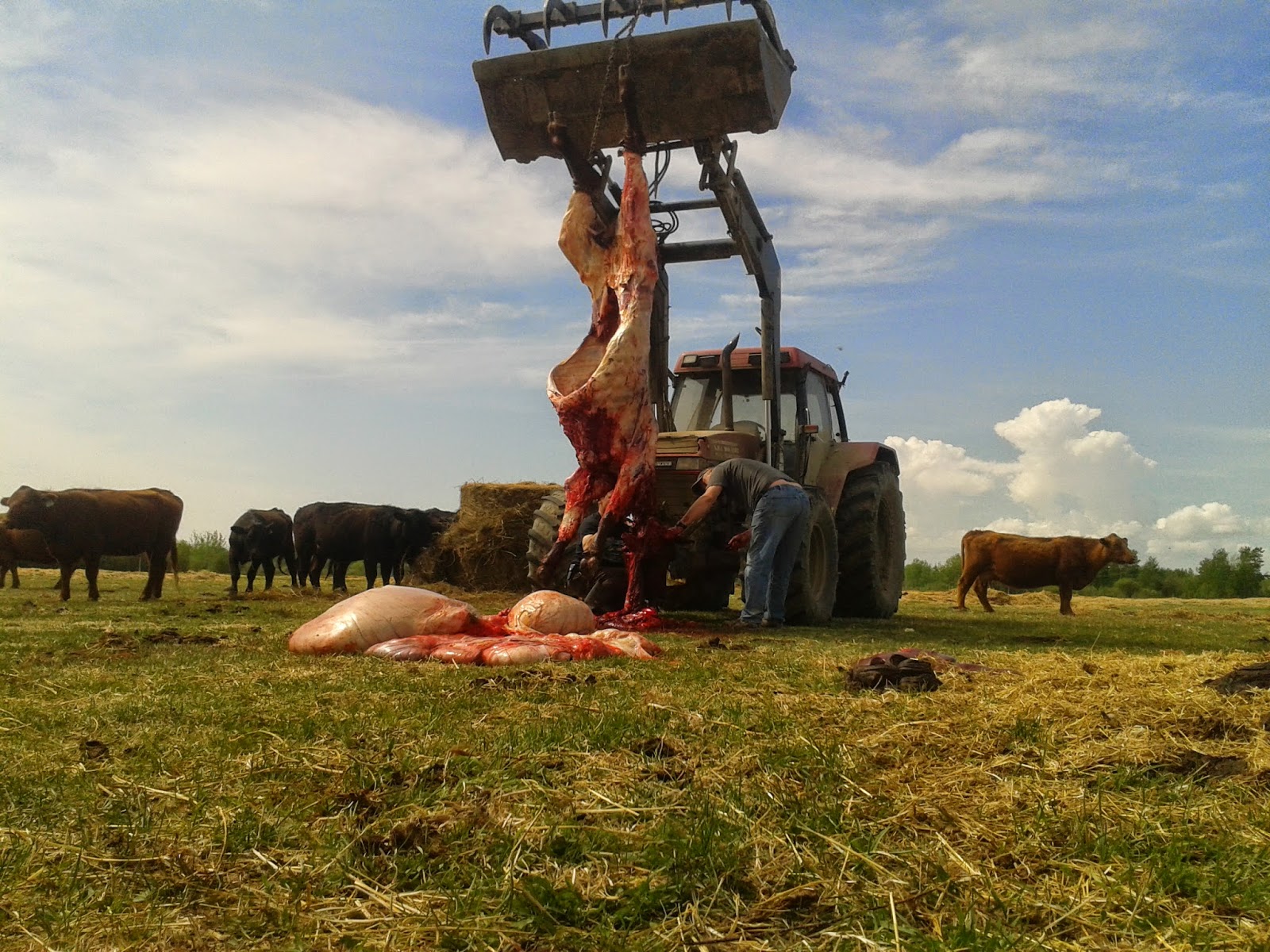
We decided that we would try a "ranchers C-section" on her,
as she was not far off calving.
So, she was shot and immediately Eric and Dale,
 cut open the dead cow and pulled out the calf.
Wonder above wonder,
a lovely,
almost full term little red heifer calf was born.


She looked a bit stunned from being ripped from the womb of her dead mother,
but we got her going, rubbed her down and  tubed her colostrum.
We watched her battle through the day with her breathing.
She could not stand yet and no sucking reflex.
By night, we wondered if she would make it.

I blanketed her and fed her late last night.
This morning she was looking brighter, her breathing calmed and with a little help
she stood up and walked a few paces.
By this afternoon she walked some more, drank from a bottle
and things  are definitely looking a lot brighter for her.

We can only do our best, and give her a chance.
This is also the only heifer calf this cow has produced for us,
so out of sentimental feelings,
 we really hope she will survive and become a future cow in our herd.

The old cow did not go to waste,
she was cut up and will be fed to the dogs.


Thank you Dale for your help!
It is very much appreciated.

The other "news" from this weekend has to do with the little baby owls.
The smallest of the baby owls,
the ones I blogged about HERE,
was not doing well.
It could not fly yet and was still sitting on the road just waiting for a predator to come a long and eat it.

Our neighbor saw it and brought it to us.
We debated what to do,
and decided to give it a chance;  these hawk owls are not very common.
We will feed him and
when he is strong enough,
we will release him.

For now, we have him in a big shed, full of trees and branches.
We bring him mice, pieces of chicken guts and strips of  cow liver.
He is eating well.


As for the bison,
he is still hanging around in the neighborhood.

The pups are huge,
growing like weeds and very active.
More about them later this week,
and of course some more photo's!


My horse is still pregnant!


Friday, 16 May 2014

Dog food

Feeding a pack of livestock guardian dogs can be expensive.
However there are a number of ways to help reduce the overall feeding costs.
This is how we “do it.”
How we "do it" does not mean to say how you should do it.
Each one to their own choices and decisions.

Feeding dogs is always regarded as a “hot topic” among dog breeders and dog owners. 
Some swear by certain brands, others by raw feeding, yet others by “traditional” foods that dogs would eat in their land of origin.

I have the simple belief to feed what we have,
what is available,
 as best as we economically can,
and as naturally possible.

I am not influenced by fads, great marketing, or clever packaging of big brand names of dog food.
In fact, I am actually fairly adverse to these gimmicks in the dog food industry.
I like to keep it simple and affordable.

So, this is what we do most of the time with our adult dogs.
We are feeding 8 Sarplaninac dogs,that is over 800 lbs. of dog,
 every day.
(Add some more, for all the border collies, too...)

For the most part, their diet consists of raw feeding.
By raw feeding, I mean we feed whole carcasses cut up for our dogs.
We have a livestock ranch, and where you have livestock, you also have dead stock.
As we check all our animals twice daily, if we have a dead sheep or cow,
we usually find it in a “fairly fresh” state.
Dogs have evolved and have adapted to many types of diets, their stomach acid is very powerful, and they are able to digest very stinky, rotten meat without too many ill side effects.
We do not however, feed very stinky rotten meat,
 the dogs will sometimes bury it, or hide it and then dig up later to chew on again.

Lucy with her beef

We will take the dead animal (whose body has been protected by the dogs until we arrive) and freeze it.
We have a freezer dedicated to dog food.
The sheep are frozen for at least 2 weeks.
If we have lambs/chickens/calves who die, they too end up in the freezer.
In the winter it is very convenient, with temperatures below minus 20, we can easily freeze the carcasses outside and do not need the freezer (advantages to living in Canada!).

After a violent bull fight we were left with 3 dead, they became the winter food for the dogs. 

After being frozen for a few weeks (we do this to kill the tapeworm that causes C-Ovis in sheep),
Eric will take his chainsaw and just cut the sheep up into thick slices.

Eric cutting up a bull for the dogs.

 The whole carcass gets used--guts, stomach, bones, and all.
Usually these pieces are pretty chunky so the dogs may only get fed once every two days.

Putting it into an economic perspective:
An 18 kg bag of kibble costs about $40 per bag and our dogs eat a bag every 2 days.
A dead ewe has $0 value, as she is dead.
When utilized for the dogs, as food, she has a value.
Our dogs eat 3-4 days from her.
The dead sheep is now saving us $60-$80 in feed costs.
So, instead of having a loss from the dead animal we actually "profit" from her death.

Many people warn us that once the dogs have “tasted lamb” or "tasted blood" they will not be reliable as LGDs anymore.
This is not true; the dogs can clearly distinguish between a live animal and a dead animal.
They will protect a carcass, and then when cut up and offered as a meal a few weeks later, will willingly eat it then.

Lucy  protecting a dead sheep carcass from ravens and other predators.

 We do not leave whole carcasses out for the dogs to eat from.
We like to know “what” the animal died from, so do not want the dogs to scavenge on carcasses.

By removing and feeding the dead stock we remove any attractants for predators.
If there are no carcasses to dig up or scavenge on, most predators will move on.
In studies it has been found that feeding off dead animal piles encourages predators to hang around,
who will then more likely start predating on livestock.
Removing carcasses or dead piles,
can decrease predation by 55 times!
If we do have a dead animal that we will not feed,
we compost that carcass to dispose of it.


If we have no dead stock available, we may choose to butcher some cull animals for the dogs.
This could be an old ewe, or one with a bad udder or one who is too thin, in fact, anyone who is on the cull list. We will slaughter the cull and proceed with freezing and later cutting.

Fena enjoying some elk ribs.

 The value of a cull animal is higher as dog food than it is to sell her.
Transport costs, auction costs, and commission costs are simply too high for the amount you will make from selling her.
Feeding her to the dogs is economically a better choice.
Dog kibble is expensive, feeding fresh mutton is cheap and is a high value food.

Shadow with a day or two's worth of meat.
 Not only that, I would also argue that it is better for the welfare of that cull animal,
who does not have to undergo the stress of a 7 hour transport,
going through an auction barn,
 being shipped to a slaughter plant possibly on the other side of Canada.
She simply and humanely gets killed right here at the ranch where she was born and has spent her life.

Another added value is that you are feeding your dogs a high quality (local) diet,
better than kibble made in some far away country, with unknown ingredients, risk of recalls, and poor processing.
At certain times of the year, one can often collect hunting scraps and get butchering remains.
We have laying hens so a few eggs can also be added to their diet as needed.

Hunting scraps

There are times when we do feed kibble, our dogs are flexible, and they eat what they are offered.
Sometimes, when travelling it is convenient to feed kibble rather than taking some sheep chunks along with us.

When we do feed kibble, we feed a mid range kibble,
we do not fuss about corn gluten or animal by products.
We feed a standard maintenance kibble.
However, feeding kibble in among hundreds of sheep is quite a chore,
 as the sheep really like and want to eat the kibble!

Our dogs are healthy, fit, and energetic, have no allergies, have great coats and strong clean teeth, and are never ill.
Is their diet balanced?
Well, I like to believe so, based on their health and their appearance.
I feed to need.
More work, very cold, then the dogs get more.

When feeding pups, I will raise them on a raw diet and also feed them kibble so that they can transition well into a home that may not be feeding a raw diet.
The pups get a standard (Purina) puppy food, that is easily obtainable all over. 

I believe the benefits of feeding old and dead stock are high.
The only disadvantage may be that the cutting up part is a little gory.

Going from carcass to dog food.

 Seeing the dogs enjoying a healthy meal of mutton or beef, knowing we have recycled, made the best economic decision (rather than dumping the dead, we create a value for that dead animal), made a humane choice for the cull animal, and removed attractants for wildlife
makes this way of feeding a good choice.
As the old saying goes, “Waste not, want not.”

Vuk, sheer bliss.


Related Posts Plugin for WordPress, Blogger...